

If the Laptop Rich Challenge or “Freedom Income” ads have been following you around Facebook lately, you’re not alone. I started seeing them everywhere too, same promises, same emotional hooks, different branding.
And that’s exactly why I’m writing this review.
This isn’t my first time reviewing a program tied to Robby Blanchard. Over the past year, I’ve already published in-depth reviews of Freedom Affiliate Formula and other affiliate systems operating inside the same ecosystem. What began as individual reviews has now revealed a clear pattern.
New name.
New landing page.
Same underlying funnel.
The Laptop Rich Challenge is being promoted as a free, beginner-friendly way to earn online with no product, no website, and no experience. Some ads brand it as Freedom Income, others as Laptop Rich, but the messaging feels instantly familiar if you’ve seen Robby Blanchard promotions before.
This review isn’t based on rumors or one ad screenshot. It’s based on pattern recognition, comparing this latest launch against multiple Robby Blanchard programs I’ve already analyzed, along with similar systems promoted by Adam Cherrington, including Invisible Affiliate and Adams Method.
So instead of asking “Is Laptop Rich a scam?”, the better question is:
Is this another rebranded entry point into the same affiliate marketing funnel?
That’s what we’re going to break down — clearly, calmly, and without hype.
Why the Laptop Rich Challenge Is Suddenly Everywhere on Facebook
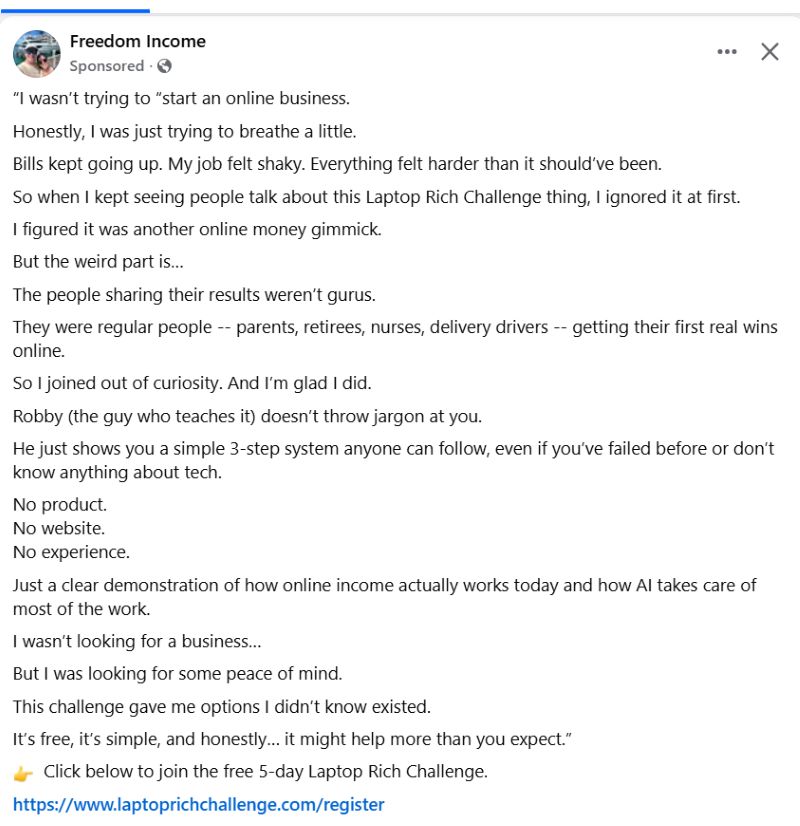
When a program suddenly floods Facebook with ads, that’s never accidental — and it’s almost always strategic.
Over the past several weeks, the Laptop Rich Challenge (often branded instead as “Freedom Income”) has been running aggressively across Facebook and Instagram. The ads show up in newsfeeds, reels, and stories, usually framed as personal breakthroughs rather than business promotions.
This type of saturation typically signals one of three things:
A new funnel is being tested at scale
An older offer is being rebranded to reset skepticism
A closed or restricted program needs new entry points
Based on my prior reviews of Robby Blanchard–related systems — especially Freedom Affiliate Formula — this looks very familiar.
Same Story, Different Wrapper
Although the branding changes from ad to ad, the underlying messaging is almost identical:
Someone is stressed about money or job security
They “weren’t looking for a business” — just relief
They discovered a simple system
No product, no website, no experience required
AI allegedly handles most of the work
A free challenge becomes the gateway
Some ads call it Laptop Rich.
Others call it Freedom Income.
But the structure is the same — and if you’ve seen Robby Blanchard promotions before, the tone is instantly recognizable.
This is not coincidence.
It’s continuity.
Why Facebook Ads Are the Chosen Weapon
Facebook remains the perfect platform for this type of promotion because:
Emotional storytelling performs extremely well
Short-form video lowers skepticism
Brand names reset faster than reputations
Most users don’t Google the offer until after opting in
That’s why these funnels rotate names so frequently. Once a brand like Commission Hero becomes too well-known — or no longer openly joinable — traffic is redirected through “free challenges” instead.
Laptop Rich is not being pushed because it’s new.
It’s being pushed because it’s effective as a front door.
Why Rebrands Spike All at Once
If you’re wondering why you suddenly started seeing multiple versions of these ads at the same time, here’s why:
Marketers test dozens of creatives simultaneously
Different names are trialed against different demographics
Winning ads are scaled quickly
Losing brands disappear quietly
That’s why some users see Freedom Income, others see Laptop Rich, and some see slightly different landing pages altogether.
Different labels.
Same destination.
What This Means for You as a Consumer
When a program relies heavily on rotating Facebook ads and shifting brand names, it’s a signal that:
The business model isn’t meant to stand on its own branding
Trust is being borrowed from storytelling, not transparency
Most users are encountering the offer cold, with no context
That doesn’t automatically make it a scam.
But it does mean you should slow down — and look past the name.
Because if the branding feels interchangeable, it usually is.
I want to be clear about something up front.
Affiliate marketing itself isn’t the problem. I’ve built legitimate online income using transparent training platforms that don’t rely on rebranding, pressure-based ads, or vague promises.
The issue isn’t earning commissions — it’s how those opportunities are being presented to beginners.
If you’re brand-new and want to see what affiliate marketing looks like on a transparent, skill-building platform (with clear pricing and no “rebrand cycle” marketing), here’s my full breakdown: my honest Wealthy Affiliate review. No pressure—just the complete look inside.
Who Is Robby Blanchard? (And Why His Name Keeps Appearing)
If the name Robby Blanchard sounds familiar, it’s because it’s been attached to a growing number of affiliate marketing programs over the past several years — many of which follow the same core structure, even when the branding changes.
Robby Blanchard is best known as the face behind Commission Hero, a paid traffic–focused affiliate marketing platform that taught students how to promote high-ticket offers using funnels and ads. For a long time, Commission Hero was the primary brand associated with his training.
That has changed.
Commission Hero Isn’t the Front-Facing Offer Anymore
One of the most important details missing from current Facebook ads is that Commission Hero itself is no longer openly available for public enrollment.
Instead of directing new users straight into Commission Hero, traffic is now routed through a rotating series of free challenges and branded entry points, including:
Freedom Affiliate Formula
Laptop Rich Challenge
Freedom Income
Each of these is positioned slightly differently, but they all function as front doors into the same general ecosystem.
If that sounds confusing, that’s because it is — especially for beginners.
Someone clicking a Laptop Rich ad has no way of knowing they’re stepping into a system that has existed under multiple names, with a long history of similar promotions.
Freedom Affiliate Formula Was an Early Signal
I’ve already published a full, in-depth review of Freedom Affiliate Formula, and that review was a turning point.
At the time, it was presented as a unique opportunity — but after analyzing the structure, messaging, and upsell path, it became clear that it shared the same DNA as earlier Commission Hero–related programs.
Laptop Rich and Freedom Income follow that same blueprint.
Different name.
Different sales page.
Same core mechanics.
That’s not speculation — it’s comparison.
Why Rebranding Is Central to the Strategy
Rebranding allows marketers to:
Reset public perception
Avoid negative search history tied to older names
Test new messaging against fresh audiences
Keep Facebook ad performance high
None of this is illegal.
But when rebranding becomes frequent, it raises a legitimate question for consumers:
Why does the name keep changing if the system doesn’t?
That’s the question this review is addressing.
This Isn’t Unique to Robby Blanchard
It’s also important to say this clearly:
Robby Blanchard is not the only marketer using this approach.
I’ve reviewed similar affiliate funnels promoted by Adam Cherrington, including Invisible Affiliate and Adams Method, and while the personalities differ, the mechanics are often strikingly similar:
Simple system framing
Beginner-friendly promises
Free or low-cost entry points
Paid programs introduced later
The difference is not whether affiliate marketing is involved.
The difference is how transparently it’s presented.
Why His Name Matters in This Review
I’m mentioning Robby Blanchard directly for one reason only:
Patterns don’t exist in isolation.
When the same individual’s name continues to surface across multiple rebranded programs — all using similar messaging, funnels, and promises — it becomes relevant context for anyone considering the latest offer.
This review isn’t about personal attacks.
It’s about connecting dots that ads don’t connect for you.
And now that we’ve established who’s behind Laptop Rich — and how it fits into a broader pattern — the next step is to look at what the Laptop Rich Challenge actually promises, versus what participants should realistically expect.
The Robby Blanchard Rebrand Pattern (Let’s Call This What It Is)

Once you step back and stop looking at Laptop Rich, Freedom Income, or Freedom Affiliate Formula as isolated offers, a consistent pattern becomes impossible to ignore.
The names change.
The branding changes.
The messaging tweaks slightly.
But the underlying system remains the same.
This is not a theory — it’s the result of comparing multiple programs tied to Robby Blanchard side by side, over time.
Programs That Share the Same DNA
Here are the most visible examples connected to this ecosystem so far:
Commission Hero – the original flagship brand, now no longer openly accessible
Freedom Affiliate Formula – positioned as a fresh opportunity, but structurally familiar
Laptop Rich Challenge – the current front-facing offer
Freedom Income – alternate branding used in Facebook ads
Additional unnamed “free challenges” quietly tested through paid traffic
Each of these is marketed as new.
None of them reinvent the model.
What Changes (On the Surface)
From the outside, these programs appear different because:
The names are refreshed
The landing pages are redesigned
The ad creatives tell new stories
The hooks shift with trends (AI, simplicity, freedom)
This creates the illusion of variety — especially for beginners encountering the ecosystem for the first time.
What Never Changes (Under the Hood)
When you look past the branding, the core mechanics stay consistent:
Funnel-based affiliate marketing
Emphasis on paid traffic, even if not stated upfront
“Free” entry points that transition into paid offers
Income implications without equal emphasis on complexity
A learning curve that’s understated in ads
This is why someone who went through Freedom Affiliate Formula will immediately recognize the structure inside Laptop Rich.
Different wrapper.
Same engine.
Why This Pattern Matters for Beginners
For experienced marketers, rebrands are easy to spot.
For beginners, they’re disorienting.
Someone searching for “Laptop Rich Challenge” has no reason to know:
It connects back to Commission Hero
It resembles Freedom Affiliate Formula
It shares mechanics with other affiliate funnels
Without that context, every new name feels like a fresh opportunity — when in reality, it’s a new entry point into an existing system.
That lack of continuity is what creates confusion.
Rebranding Isn’t Illegal — But It Isn’t Transparent Either
To be clear:
Rebranding itself is not illegal, and it’s not uncommon in online marketing.
The issue arises when:
The same system is repeatedly sold as something new
Past versions are quietly abandoned
New users are never shown the full history
At that point, it’s fair — and necessary — to call it out.
That’s what this review is doing.
Why This Keeps Repeating
This rebrand cycle works because:
Most people only see one version of the offer
Facebook ads reach users before Google research happens
New names reset skepticism and search history
Curiosity overrides caution
Until someone connects the dots.
Now that the rebrand pattern is clear, the next logical question is:
What does the Laptop Rich Challenge actually promise — and how does that compare to what participants really experience?
That’s where we’re going next.
Confused Yet? You’re Not Alone — That’s the Point
If all of this is starting to feel confusing, you’re not imagining it.
Laptop Rich.
Freedom Income.
Freedom Affiliate Formula.
Commission Hero.
Different names.
Different ads.
Same funnel mechanics.
That confusion isn’t accidental — it’s a byproduct of how these systems are designed to operate.
When entry points constantly change, it becomes harder for beginners to:
Research accurately
Compare programs objectively
Understand long-term costs
Track a platform’s actual history
Instead of building trust over time, these funnels rely on fresh branding to reset skepticism.
And that raises an important question worth asking before committing time, money, or expectations:
Would you really trust your financial goals to a platform that has to keep rebranding itself to stay effective?
That doesn’t mean affiliate marketing itself is flawed. It means stability matters — especially for beginners who don’t want to keep starting over every time a “new” opportunity appears.
After years of watching the same funnels resurface under different names, I’ve come to value platforms that:
Have a long, traceable history
Don’t depend on constant rebrands
Focus on transferable skills instead of urgency
Are transparent about pricing, expectations, and learning curves
If you want to see what that kind of stability actually looks like in practice, I break it down in detail here:
with a transparent affiliate marketing platform with a long track record
That page isn’t about hype or promises — it’s about showing how a platform with years of documented history approaches training, tools, and long-term skill development.
Clarity builds confidence.
Consistency builds trust.
And in online business, trust matters far more than a clever name.
What the Laptop Rich Challenge Promises
On the surface, the Laptop Rich Challenge is presented as a simple, low-risk way to get started earning online. The ads and registration pages emphasize accessibility, ease, and speed — especially for people who feel overwhelmed by traditional business models.
Here’s what the challenge explicitly promises or strongly implies.
A Free, Short-Term Commitment
Most versions of the offer position Laptop Rich as:
A free 5-day challenge
Roughly 60 minutes per day
No upfront credit card required
Designed for beginners with no prior experience
This framing is intentional. A short time commitment lowers resistance and makes the opportunity feel manageable, even for people who are skeptical or burned out.
“No Product, No Website, No Experience”
This is one of the most repeated claims across Laptop Rich and Freedom Income ads.
The promise is that participants don’t need to:
Create their own product
Build a website
Have technical or marketing experience
For someone new to affiliate marketing, this sounds reassuring — almost too reassuring.
What’s missing from this claim is context. While you may not need to create a product, you are still participating in affiliate marketing, which involves learning systems, tools, traffic sources, and compliance requirements that are rarely mentioned upfront.
AI Does the Heavy Lifting
Another recurring promise is that AI handles most of the work.
This is typically framed as:
Automation
Done-for-you systems
Smart tools that simplify decision-making
What’s not clearly explained in the ads is:
What the AI actually does
What still requires human input
Where learning and execution fall on the participant
“AI” is used as a confidence booster — not a technical explanation.
Affiliate Commissions Without Complexity
The challenge also leans heavily on the idea that commissions can be earned without needing to “understand everything.”
While this is appealing, it glosses over important realities:
Affiliate marketing still requires learning how traffic works
Mistakes can be costly, especially with paid ads
Results vary wildly based on skill and budget
The simplicity promised in ads is rarely matched by the complexity of execution.
Freedom, Flexibility, and Relief
Beyond the mechanics, the emotional promise is clear:
Financial breathing room
Flexibility
Less stress
A way out of uncertainty
These themes show up repeatedly across Robby Blanchard–related promotions — and they resonate because they speak to real concerns.
But emotional appeal should never replace full disclosure.
Why These Promises Sound So Familiar
If you’ve already researched or joined programs like Freedom Affiliate Formula, much of this will feel familiar.
The wording may shift slightly.
The visuals may change.
But the promise structure remains consistent:
Low barrier entry
High upside implication
Minimal emphasis on risk or learning curve
That’s not accidental — it’s designed to attract beginners before skepticism kicks in.
The Gap Between Promises and Expectations
At this stage, it’s important to pause.
None of these promises are inherently illegal.
None automatically make the Laptop Rich Challenge a scam.
But taken together — and viewed in the context of repeated rebrands — they create expectations that deserve closer examination.
Which leads to the most important question:
What actually happens once someone joins the Laptop Rich Challenge?
That’s the part ads don’t explain clearly — and that’s where we go next.
What Actually Happens Inside These Challenges (Based on the Pattern)
Once someone signs up for the Laptop Rich Challenge, the experience usually follows a familiar structure — one I’ve now seen repeated across multiple programs tied to the same ecosystem.
This section isn’t based on rumors or insider leaks. It’s based on pattern recognition from reviewing similar challenges, funnels, and training paths over time — including Freedom Affiliate Formula and comparable systems promoted by Adam Cherrington.
Step 1: Orientation and Motivation
The early part of the challenge typically focuses on:
Motivation and mindset
Reframing financial frustration as opportunity
Emphasizing simplicity and belief
Establishing trust in the system
This stage is designed to lower skepticism and help participants feel like they’re finally “in the right place.”
There’s nothing inherently wrong with this — but it’s important to recognize it for what it is: conditioning before instruction.
Step 2: Introduction to the Business Model (Without the Full Picture)
As the challenge progresses, the core business model begins to emerge:
Affiliate marketing
Promoting existing offers
Leveraging funnels and systems rather than products
What’s often missing at this stage is a full discussion of:
Paid traffic requirements
Budget realities
Platform policies
Skill development timelines
Instead, complexity is introduced gradually — after emotional buy-in has already occurred.
Step 3: Tools, Systems, and “Next Steps”
By the middle or end of the challenge, participants are typically shown:
Recommended tools
Optional systems
“Next level” training
Paid programs positioned as accelerators
These are framed as logical progressions, not upsells — even though they usually involve additional cost.
This is where the gap between free challenge and actual business becomes clear.
Step 4: The Pivot From Free to Paid
At some point, the challenge stops being about education and starts being about continuation.
Participants are encouraged to:
“Commit”
“Take the next step”
“Stop sitting on the sidelines”
Again, this isn’t illegal or unique — but it’s rarely emphasized upfront in the ads.
The challenge itself is not the business.
It’s the on-ramp.
Why This Feels Familiar to Past Participants
If you’ve been through Freedom Affiliate Formula or similar affiliate challenges before, the structure will feel almost identical:
Short free entry
Gradual reveal of complexity
Paid continuation framed as necessary
Emphasis on action over caution
That repetition is the strongest indicator that Laptop Rich is not a standalone opportunity, but rather another entry point into an existing system.
What’s Often Left Unsaid
Most challenges don’t clearly emphasize that:
Results are not typical
Paid traffic carries financial risk
Learning curves vary dramatically
Many participants never recoup ad spend
Those details are usually discovered later — after time, attention, and optimism have already been invested.
That doesn’t make the challenge a scam.
But it does mean expectations should be grounded before opting in.
Why This Matters
Understanding what happens inside the Laptop Rich Challenge reframes the entire offer.
You’re not being handed a complete business.
You’re being introduced to a pathway — one that requires continued learning, spending, and decision-making.
Once you understand that, the branding becomes less important.
And that’s when informed decisions become possible.
Personally, I prefer platforms that are transparent about costs, realistic about timelines, and focused on skill-building rather than constant rebranding. After years of trial and error in this space, I’ve learned that clarity upfront matters more than hype — especially for beginners.
Commission Hero Is No Longer the Front Door — These Challenges Are
One detail that rarely gets explained in Facebook ads — and almost never explained clearly — is the role Commission Hero plays today.
Commission Hero was once the primary brand and entry point associated with Robby Blanchard’s affiliate marketing training. For a long time, anyone interested was directed straight there.
That’s no longer the case.
Commission Hero Isn’t Publicly Accessible Like It Used To Be
At the time of writing this review, Commission Hero is not openly available for public enrollment in the way most people expect.
Instead of a single, clearly defined platform, new prospects are now funneled through rotating entry points such as:
Laptop Rich Challenge
Freedom Income
Freedom Affiliate Formula
Each of these serves the same purpose:
to warm up new users before introducing them to the broader paid ecosystem.
This shift matters more than most people realize.
Why “Free Challenges” Replaced Direct Enrollment
From a marketing standpoint, challenges solve several problems at once:
They lower resistance (“It’s free, why not?”)
They reduce refund pressure
They delay price objections
They increase emotional investment
They filter out skeptics early
Instead of asking someone to evaluate a paid platform upfront, challenges ask for time and attention first — which is often more valuable.
By the time costs are introduced, many participants already feel committed.
The Problem Isn’t the Challenge — It’s the Lack of Context
Challenges themselves are not inherently bad.
The issue is that most people joining Laptop Rich or Freedom Income have no idea:
They’re entering a long-running ecosystem
The system has existed under multiple names
Paid progression is expected
This is not a one-time opportunity
Without that context, beginners believe they’re discovering something brand new — when in reality, they’re stepping into a well-established model with a long history.
That’s where confusion starts.
Why This Setup Creates Friction for Beginners
When entry points keep changing, beginners struggle to:
Research accurately
Compare programs fairly
Understand long-term costs
Separate marketing from mechanics
Search results become fragmented.
Reviews feel contradictory.
Trust erodes quickly.
And that’s often when people either:
Quit entirely, or
Jump from one “new” system to the next
Neither outcome leads to success.
Why This Is a Critical Moment in the Review
At this point in the article, something important should be clear:
Laptop Rich isn’t meant to stand alone.
Freedom Income isn’t a separate business.
Freedom Affiliate Formula wasn’t a one-off.
They’re access points, not destinations.
Understanding that changes how you evaluate everything that comes next — including whether this style of affiliate marketing even fits your goals, budget, and tolerance for risk.
And now that the structure is clear, the next step is to look at how Laptop Rich compares directly to similar programs, including ones I’ve already reviewed in detail.
That’s where the differences — and similarities — really stand out.
How This Compares to Freedom Affiliate Formula and Adam Cherrington’s Programs
Once you understand that Laptop Rich is not a standalone opportunity, the next logical step is comparison — not hype-driven comparison, but structural comparison.
I’ve already published full, in-depth reviews of:
So instead of rehashing those reviews here, this section focuses on how Laptop Rich fits into the same broader category — and where it overlaps.
Laptop Rich vs Freedom Affiliate Formula
If you’ve read my Freedom Affiliate Formula review, much of Laptop Rich will feel familiar almost immediately.
Both are:
Positioned as beginner-friendly entry points
Introduced through “free” or low-barrier access
Built around affiliate marketing funnels
Designed to lead into paid systems later
The biggest difference is presentation, not structure.
Freedom Affiliate Formula leaned more heavily on branding itself as a “formula,” while Laptop Rich emphasizes lifestyle imagery and simplicity language. Underneath, however, the learning curve and progression path are comparable.
| Feature | Laptop Rich Challenge | Freedom Affiliate Formula |
|---|---|---|
| Entry Method | Free multi-day challenge promoted via Facebook ads | Free or low-cost entry funnel promoted via paid traffic |
| Upfront Cost Transparency | Limited; paid components introduced later | Limited; full costs revealed progressively |
| Primary Business Model | Affiliate marketing using funnels | Affiliate marketing using funnels |
| Paid Traffic Emphasis | Often implied rather than clearly stated upfront | Often implied rather than clearly stated upfront |
| Learning Curve | Understated in marketing | Understated in marketing |
| Rebranding History | High (Laptop Rich / Freedom Income) | Moderate to high |
| Long-Term Dependency | Strong reliance on continued upsells | Strong reliance on continued upsells |
Laptop Rich vs Adam Cherrington’s Invisible Affiliate
Adam Cherrington’s Invisible Affiliate uses a different personality and tone, but the appeal is strikingly similar:
Minimal setup promised
Automation emphasized
“System does the work” framing
Funnel-based affiliate model
Where Laptop Rich relies heavily on challenge-style onboarding, Invisible Affiliate focuses more on pre-built assets and delegation language. But in both cases, the simplicity is front-loaded — while the real complexity shows up later.
For beginners, this distinction matters less than it seems.
The risk profile is similar:
Laptop Rich vs Adam Cherrington’s Adams Method
Adams Method positions itself slightly differently, often emphasizing process and structure over lifestyle imagery. Even so, the mechanics remain familiar:
Affiliate-based income
Funnel-driven execution
Paid progression required
Results dependent on execution and budget
The main difference is messaging, not outcome.
Laptop Rich sells relief.
Adams Method sells simplicity.
Neither removes the underlying work.
| Feature | Laptop Rich Challenge | Adams Method |
|---|---|---|
| Core Positioning | Lifestyle freedom through a simple challenge | Structured process-driven affiliate system |
| Entry Experience | Free challenge as onboarding | Low-cost program with layered upsells |
| Learning Emphasis | Secondary to system execution | Process explained, but complexity understated |
| Monetization Method | Affiliate funnels promoted via traffic | Affiliate funnels promoted via traffic |
| Cost Transparency | Delayed until after commitment | Partially disclosed, expands with upgrades |
| Rebranding History | Multiple names and ad variants | Less frequent, but similar funnel structure |
| Long-Term Viability | Dependent on ongoing funnel relevance | Dependent on continued system updates |
Why These Comparisons Matter
This isn’t about declaring one program “better” than another.
It’s about recognizing a category of offers that:
Use different names
Rotate branding
Promise simplicity
Downplay long-term commitment
Once you recognize the category, it becomes easier to evaluate any new launch — regardless of whose name is on it.
That’s the real value of comparison.
What This Should Tell You So Far
By now, a few things should be clear:
Laptop Rich is not unique
The business model is familiar
Rebranding is a feature, not a bug
Beginner expectations are often misaligned
That doesn’t mean these programs can’t work.
It means they require:
Capital
Tolerance for risk
A steep learning curve
Clear-eyed expectations
And that leads naturally to the next question:
What should beginners actually look for if they want long-term success — without chasing rebrands?
That’s where we go next.
Red Flags Beginners Should Understand Before Joining
By this point in the review, one thing should be clear:
the Laptop Rich Challenge isn’t operating in isolation.
That doesn’t automatically make it a scam — but it does mean beginners need to slow down and evaluate what’s really being offered.
Here are the most important red flags to understand before opting in.
Frequent Rebranding Is a Warning Sign
When the same system appears under multiple names — Laptop Rich, Freedom Income, Freedom Affiliate Formula — it creates confusion for a reason.
Rebranding:
Resets search history
Buries past reviews
Makes research harder
Forces beginners to start from scratch
Stable businesses don’t need constant name changes.
They build trust over time.
“Free” Entry Points That Require Paid Continuation
A free challenge sounds harmless — and it often is.
The red flag appears when:
The challenge is framed as the opportunity
Paid progression isn’t clearly disclosed upfront
Continuing feels mandatory to “make it work”
At that point, “free” becomes a commitment funnel, not a gift.
Vague AI Claims Without Clear Explanation
AI is a powerful tool — when it’s clearly defined.
When it’s used as:
A buzzword
A shortcut
A stand-in for learning
…it becomes misleading.
If you don’t understand what the AI actually does, you’re still the one taking the risk.
Income Implications Without Equal Risk Disclosure
Words like:
Freedom
Relief
Simplicity
Passive
Carry emotional weight.
But affiliate marketing — especially models involving funnels or ads — carries financial and learning risk that rarely shows up in ads.
Any opportunity that emphasizes upside without discussing downside deserves extra scrutiny.
Systems That Downplay Skill Development
This is one of the biggest long-term problems with rebranded funnels.
When the focus is:
“Just follow the system”
“Plug into our process”
“We’ve already done the hard part”
Skill-building gets sidelined.
And without skills, people stay dependent — jumping from one “new” system to the next.
Why These Red Flags Matter
None of these issues mean someone can’t succeed.
They mean success depends on:
Capital
Risk tolerance
Learning speed
Personal accountability
For beginners looking for clarity, stability, and transferable skills, that matters a lot.
And it naturally raises the next question:
Is there a way to learn affiliate marketing without chasing rebrands and without being rushed through funnels?
That’s where internal education — not another pitch — becomes important.
Better Alternatives for Beginners (Without the Rebranding Cycle)
By now, it should be clear that the biggest issue with programs like Laptop Rich, Freedom Income, and similar challenges isn’t affiliate marketing itself.
It’s the constant rebranding, the lack of continuity, and the way complexity is delayed until after emotional buy-in.
For beginners, that creates confusion — and often burnout.
So instead of jumping from one “new” system to the next, it’s worth stepping back and asking a more important question:
What does a stable, transparent path into affiliate marketing actually look like?
I explore that question in detail in my honest Wealthy Affiliate review, where I break down the training platform I’ve personally used since 2014 to build affiliate marketing websites across multiple niches. The focus there isn’t hype or shortcuts — it’s skill development, transparency, and long-term consistency.
What Beginners Should Be Looking For Instead
A solid alternative doesn’t need flashy ads or rotating brand names.
At a minimum, beginners should look for:
Clear upfront pricing, not delayed reveals
One consistent platform, not multiple entry points
Skill-based training, not “just follow the system”
Long-term access, not time-limited challenges
A real community, not isolated funnels
Most importantly, beginners should be able to understand:
What they’re learning
Why they’re learning it
How the skills transfer beyond one offer
If a platform can’t explain that clearly, it’s usually because it relies on momentum, not mastery.
Why Transparency Matters More Than “Speed”
One of the biggest selling points in rebranded challenges is speed:
Fast results
Quick wins
Short timelines
But speed without understanding creates dependence.
When you learn how affiliate marketing works — instead of just being told what to do — you’re no longer tied to:
One funnel
One brand
One personality
That’s the difference between building a business and renting a system.
My Personal Bias (Being Upfront About It)
I want to be transparent here.
I strongly prefer platforms that:
Teach the fundamentals
Don’t rely on constant rebranding
Make costs and expectations clear from day one
After years of trial and error in this space, I’ve found that stability and skill development matter far more than hype — especially for people who are new and don’t want to keep starting over.
I’ve broken down my own experience, including what worked and what didn’t, in a separate, detailed review here:
See my up-to-date look inside Wealthy Affiliate
(No pressure — it’s there for context if you want to see what a transparent platform actually looks like.)
That page goes much deeper into:
Pricing
Training structure
Pros and cons
Who it’s actually for (and who it isn’t)
This article isn’t the place to sell anything — it’s the place to help you think clearly.
Why I’m Not Pushing a “Quick Fix” Here
If you’ve made it this far into the review, you already know there are no shortcuts that eliminate:
Learning
Effort
Mistakes
Any platform that suggests otherwise — especially through rebranding and emotional ads — deserves skepticism.
The goal isn’t to find the easiest system.
It’s to find one you don’t have to keep replacing.
How This Ties Back to Laptop Rich
Understanding what good looks like makes it easier to evaluate what Laptop Rich actually offers.
If you’re comfortable with:
Paid traffic risk
Funnel dependency
Ongoing upsells
A system that may reappear under a new name
Then Laptop Rich might make sense for you.
If not, it’s worth slowing down and choosing clarity over urgency.
One Final Thought Before the Verdict
Programs come and go.
Names change.
Ads disappear.
But the skills you build — or don’t build — stay with you.
That’s the lens I encourage you to use when evaluating any affiliate marketing opportunity, not just Laptop Rich.
Is the Laptop Rich Challenge a Scam?
This is the question most people are really asking — and after everything we’ve covered, it deserves a clear, straightforward answer.
Short answer: No, the Laptop Rich Challenge is not an outright scam.
But that answer needs context.
Why It’s Not a Scam
The Laptop Rich Challenge:
Exists
Delivers some form of training
Introduces a real business model (affiliate marketing)
Does not appear to take money without providing anything in return
There’s nothing illegal about running a free challenge or teaching affiliate marketing.
Calling it a “scam” would oversimplify what’s actually happening.
Why It’s Still Problematic for Beginners
Where Laptop Rich becomes an issue is expectation management.
Based on the ads, branding, and onboarding approach, many beginners walk in expecting:
A complete business
Minimal learning
Little to no risk
Fast results
What they’re actually stepping into is:
A pathway, not a business
A model that often involves paid traffic
A system with ongoing costs
A steep learning curve that’s introduced gradually
That disconnect is where frustration starts.
The Rebranding Factor Can’t Be Ignored
Even if each individual version of the program delivers something, the repeated rebranding matters.
When:
The same system appears under multiple names
Past versions quietly fade away
New users aren’t shown the full history
It becomes harder for beginners to make informed decisions.
That doesn’t make the system fraudulent — but it does make it less transparent than many people realize.
Who the Laptop Rich Challenge Might Be For
To be fair, Laptop Rich may appeal to people who:
Already understand affiliate marketing basics
Are comfortable with funnels and paid traffic
Have disposable budget for testing
Accept that upsells are part of the process
For someone with that background, the structure won’t be surprising.
Who Should Think Twice Before Joining
Beginners should slow down if they:
Are looking for a complete business in a box
Don’t have money to risk on ads
Want one stable platform, not rotating entry points
Prefer upfront clarity over gradual reveals
If that sounds like you, the Laptop Rich Challenge may not align with your expectations — regardless of how convincing the ads are.
The Bottom Line
The Laptop Rich Challenge isn’t a scam.
But it is another rebranded entry point into a familiar affiliate marketing funnel — one that relies heavily on emotional advertising, delayed complexity, and paid progression.
Whether that’s acceptable depends entirely on what you’re actually looking for.
The most important thing is understanding what you’re getting into before you opt in, not after.
Final Thought
If you’ve made it this far, you’ve already done something most people don’t:
You stopped.
You researched.
You looked past the branding.
That alone puts you ahead of the curve.
And no matter what you choose next, that mindset will serve you far better than any “free challenge” ever could.
A Final Thought (Before You Click Anything)
If you’ve made it this far, you’ve already done more due diligence than most people ever do before opting into an online “opportunity.”
You didn’t just watch an ad.
You didn’t just trust a landing page.
You stopped, researched, and looked for patterns.
That matters.
Programs like Laptop Rich, Freedom Income, and similar challenges thrive on speed — on catching people before they have time to connect the dots. Once you slow down and see how often the same systems reappear under different names, the urgency fades and clarity takes its place.
That doesn’t mean affiliate marketing is bad.
It means how it’s presented matters.
My goal with Scam Busters USA has never been to tell people what to buy or what to avoid blindly. It’s to document what’s actually happening behind the scenes so you can make decisions with your eyes open — not based on hype, fear, or pressure.
If you’ve seen Laptop Rich ads, Freedom Income ads, or similar promotions elsewhere, I’d love to hear about it.
Where did you see them?
What caught your attention?
Did anything feel off — or genuinely helpful?
Leave a comment below and share your experience.
Those conversations help others far more than another ad ever will.
Affiliate Disclosure:
This article may contain affiliate links. If you choose to make a purchase through one of these links, I may earn a commission at no additional cost to you. Any recommendations or references are based on personal experience and research, and are shared for informational purposes only.
About the Author

My name is Jason Taft, and I’m the founder of Scam Busters USA, a consumer-advocacy website dedicated to investigating online business opportunities, affiliate marketing programs, and “make money online” systems.
I’ve been active in the online business space since 2011, and like many beginners, I learned the hard way. Between 2011 and 2014, I personally experienced how aggressive marketing, rebranded funnels, and unrealistic income claims can mislead people who are simply trying to build something legitimate online.
Those experiences are the reason Scam Busters USA exists.
Over the years, I’ve published hundreds of in-depth reviews and educational articles, breaking down affiliate programs, digital products, and emerging online trends. My focus isn’t hype or quick wins — it’s identifying patterns, exposing misleading marketing, and helping readers understand how these systems actually work before they risk their time or money.
I’m not anti-affiliate marketing. I’m anti-misrepresentation.
When I link to additional resources or alternatives, it’s done transparently and separately from investigative content, so readers can clearly distinguish education from opinion. My goal is to help people make informed decisions — not pressured ones.
You can find more of my work at ScamBustersUSA.com, where I regularly publish new reviews and scam alerts as online marketing trends evolve.
How many people have actually seen success on their terms with Laptop Rich? I don’t mean to sound like a hater, but it gets me nervous as a pure hearted marketer in many ways when it sounds like a bunch of eggs are being put into one basket without much parity. I’d like to believe the laptop rich concept is true, but I also would like to see different angles of the end goal being reached by different faces.
Great question, Adrian, and honestly, your concern is a healthy one, not “hating” at all.
To answer it plainly: there are very few publicly documented examples of people achieving long-term, independent success on their own terms using Laptop Rich alone. Most of what’s shown are short-term wins tied closely to the same funnels, same traffic sources, and the same launch cycles.
That’s exactly where the “all eggs in one basket” issue comes in.
When a system:
relies heavily on one platform,
teaches one primary traffic method,
and refreshes itself through rebranding rather than expansion,
success tends to cluster around a small group who are early, aggressive, or already experienced, not a wide range of everyday marketers building durable assets.
Your instinct about parity is spot on. In sustainable affiliate marketing, you usually see:
different niches,
different content styles,
different personalities,
and different paths to the same end goal.
When those angles are missing, it’s worth slowing down and asking why.
I’m not saying no one makes money with Laptop Rich, but for someone who values transparency and long-term independence, it’s wise to question whether the model encourages ownership and adaptability, or just participation in a tightly controlled system.
Appreciate you bringing a thoughtful, principled perspective to the conversation. These are exactly the questions more people should be asking before committing time and money.
— Jason