

Is It Really Worth It?
Blog Growth Engine (BGE) has become one of the most talked-about blogging and affiliate marketing courses online. Scroll through YouTube or any affiliate marketing forum, and chances are you’ll see heated debates about whether this program is a goldmine for aspiring bloggers, or just another overpriced hype machine.
And here’s why: the course doesn’t just teach you how to start a blog. It promises a full blueprint for turning your blog into a business asset that earns real money through affiliate marketing, sponsorships, and even productized services. With Adam Enfroy, the man who went from zero to multi–seven-figures in just a few years—at the helm, the hype around Blog Growth Engine is impossible to ignore.
Important Update: Blog Growth Engine 4.0
In late 2024, Adam and his team rolled out Blog Growth Engine 4.0, a refreshed version of the program. This update wasn’t just cosmetic—it added entire new frameworks for AI-assisted workflows, topical mapping strategies, and step-by-step processes to scale your content output without burning out. In short, it made the course feel far more current for 2025 and beyond.
If you’ve heard older reviews complaining that the course was “too rigid” or missing key steps, know this: the latest version addresses many of those pain points. The training is deeper, the tools are sharper, and the accountability systems are stronger than ever.
👋 A Quick Personal Note
I’ve personally tested over 100 affiliate marketing and blogging courses over the years. Some were cheap $7 PDFs. Others were $2,000+ “secret systems.” Most of them had one thing in common: lots of hype, little substance, and a frustrating lack of practical guidance.
That’s why I write reviews like this one. My goal isn’t to sell you on every shiny new course—it’s to give you a no-fluff breakdown of what’s inside, what’s good, what’s missing, and whether it’s worth your money. I’ll also compare it to the platform I personally use and recommend (Wealthy Affiliate), so you can see the difference side by side.
⚡ Quick Verdict (Snapshot)
⭐ My Rating: 3.8 out of 5
Pros:
- In-depth blogging + SEO training with step-by-step lessons
- Regular updates (now includes AI frameworks and topical mapping)
- Strong credibility (Adam Enfroy has real-world results)
- Private community + live coaching elements
Cons:
- High price point ($997 even after discount)
- Steep learning curve for beginners with no SEO experience
- Requires extra tools (hosting, keyword software, etc.)
- Not the best option if you’re on a tight budget
Bottom line? Blog Growth Engine is legit, detailed, and capable of producing results—but it comes at a steep cost and requires serious commitment. If you’re looking for a more beginner-friendly and affordable way to learn affiliate marketing, I’ll show you why Wealthy Affiliate is still my #1 recommendation.
What Is Blog Growth Engine?
When people talk about “blogging courses,” there are usually two camps: outdated eBooks that barely scratch the surface and multi-thousand-dollar masterminds that overpromise and underdeliver. Blog Growth Engine positioned itself as something different—a structured, high-ticket program that promised to help you build a blog into a six-figure business asset.
Let’s break down what Blog Growth Engine really is, how it started, and what changed with the latest 4.0 version.
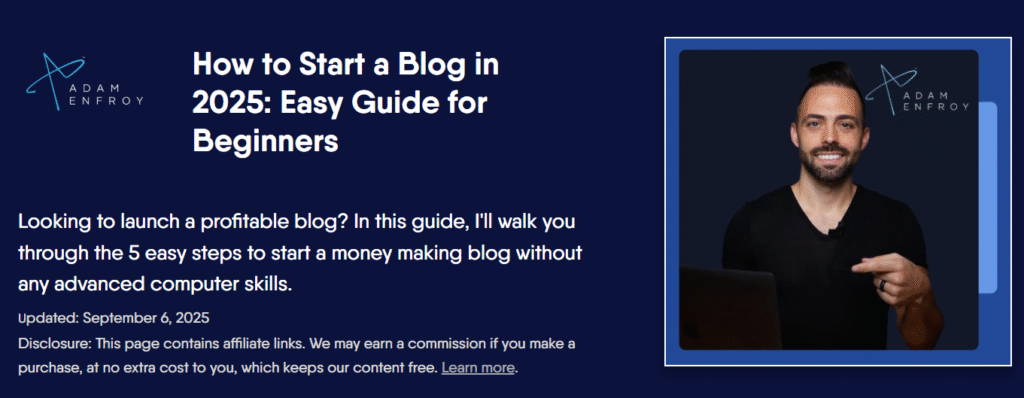
The Beginning: Blog Growth Engine’s Launch in 2019
Blog Growth Engine was launched in 2019 by Adam Enfroy, a blogger who went from publishing his first post to generating multiple six figures in less than two years. Adam built his personal brand on transparency: he shared screenshots of his traffic, income reports, and behind-the-scenes processes for growing his blog.
This authenticity gave him credibility fast. Unlike faceless “gurus” who brag about passive income but never show proof, Adam documented his blogging journey in real time. By 2020, his blog was bringing in serious money—through affiliate marketing, sponsorships, and digital products. That real-world success became the foundation for his course.
When Blog Growth Engine first hit the market, it immediately stood out because:
It wasn’t about quick hacks or spammy tactics.
It emphasized treating your blog as a startup, not a hobby.
It combined mindset training with technical SEO and monetization strategies.
For beginners who were tired of fluff and wanted a roadmap, BGE felt like a breath of fresh air.
Evolution: From Legacy to BGE 4.0
Like any good online program, Blog Growth Engine didn’t stay static. Over the years, Adam and his team iterated, refined, and expanded the content.
BGE (Legacy): The original course included modules on mindset, niche selection, keyword research, minimum viable websites, content creation, and monetization. It was good, but some lessons aged quickly as Google algorithms evolved.
BGE 2.0 and 3.0: These updates added more detail around search intent, link building, and scaling. They also improved the course structure so students could progress step by step instead of feeling overwhelmed.
BGE 4.0 (2024 Update): This is the current version, and it’s the biggest overhaul yet. It introduces new phases, AI-driven blogging workflows, topical mapping strategies, and bonus content to help students stay accountable and motivated.
This evolutionary cycle shows one thing clearly: Adam knows blogging changes fast, and he doesn’t want his course to fall behind.
The Core Promise
From day one, Blog Growth Engine marketed itself with a bold promise:
👉 You can build a blog capable of generating $10K/month in income.
Now, to be fair, Adam never said this would happen overnight. In fact, one of his recurring themes is that blogging is a long-term play. But he did design the system to give students a straight path toward turning a blog into a business asset.
The core process can be summarized as:
Mindset Reset – Stop treating your blog like a diary; treat it like a startup.
Choose a Profitable Niche – Validate your topic with keyword and monetization research.
Build a Minimum Viable Website – Simple, clean design focused on speed and structure.
Keyword Monetization – Target phrases that drive both traffic and revenue.
Content Creation Engine – Produce informational posts, transactional reviews, and link-worthy articles.
Link Building – Use outreach and HARO to grow authority.
Monetization – Diversify with affiliate marketing, sponsorships, and eventually, products.
Scaling – Outsource writing, streamline processes, and grow into a true authority site.
That’s the DNA of Blog Growth Engine. The idea isn’t to pump out random content—it’s to build a brand that ranks, monetizes, and compounds over time.
What’s New in Blog Growth Engine 4.0?
The 4.0 version, released at the end of 2024, is where things really get interesting. Here’s what changed:
1. AI Workflows and Frameworks
The new BGE includes entire modules on how to use AI responsibly for content research, outlines, and productivity. Adam is clear: AI isn’t about pumping out low-quality spam. Instead, he shows how to use tools like ChatGPT and Jasper to augment your content strategy—so you can scale without burning out.
This addition matters because the blogging landscape in 2025 looks different than it did in 2019. AI is everywhere, and ignoring it would leave students behind.
2. Topical Mapping and Content Clusters
The course now dives deeper into topical authority—organizing your content into clusters that build expertise in Google’s eyes. This helps you rank faster and beat competitors who scatter random blog posts across unrelated topics.
This was a big gap in earlier versions of BGE, so the 4.0 update fills an important hole.
3. Mindset and Accountability Bonuses
Blogging isn’t just technical—it’s also psychological. Many students quit after three months because they don’t see results. To address this, BGE 4.0 added bonus lessons from co-instructors like Chris Startkhagen, who teaches productivity systems, accountability frameworks, and ways to beat procrastination.
This helps students stay consistent long enough to see results, which is often the biggest hurdle.
4. Updated Phases and Blueprints
The older BGE course was around 40 hours of content. The new 4.0 version expands on that with:
A full web copywriting masterclass (taught by Kevin Meng).
A more advanced link-building playbook (led by Jessica La and Hanson Cheng).
A deeper dive into monetization options beyond just affiliate marketing, including sponsorships, agencies, and freelancing.
Training on content updating strategies to survive Google’s ever-changing algorithms.
Together, these updates make the course feel more holistic—less about just starting a blog, and more about building a sustainable online business.
Why People Still Talk About It
Even with the price tag ($997 after discount), Blog Growth Engine continues to dominate conversations in affiliate marketing circles. Why?
Adam’s Proof of Success – He’s not just teaching theory; he’s done it himself.
Comprehensive Scope – From mindset to scaling, the course covers every stage.
Regular Updates – Many courses sit stagnant. BGE evolves.
Community Access – The private Skool group gives students peer support and direct interaction with coaches.
That combination makes Blog Growth Engine feel like one of the few blogging courses that isn’t just a money grab.
The Bottom Line on What BGE Is
Blog Growth Engine is a premium blogging course designed to help students build a $10K/month business from scratch. Launched in 2019, it’s evolved through multiple updates and is now in its 4.0 version, which integrates AI tools, topical mapping, and productivity systems alongside the original blogging fundamentals.
But here’s the catch: it’s not cheap, it’s not beginner-proof, and it requires a lot of time. The promise is real, but so are the demands.
That’s why in the next sections of this review, I’ll break down what’s inside, what works, what doesn’t—and how it stacks up against a more affordable alternative I’ve used for years: Wealthy Affiliate.
Who Created Blog Growth Engine (And Why It Matters)
One of the first things you should ask when evaluating any online course is simple: who’s behind it, and do they actually practice what they preach?
Blog Growth Engine was created by Adam Enfroy, but it’s not a one-man show anymore. Over the years, he’s built a team of instructors and guest experts who contribute to different phases of the course. That’s one of the reasons it has stood out compared to cheaper, “single-teacher” courses that don’t evolve.
Let’s dig into who Adam is, who the co-instructors are, and why this matters for anyone thinking about investing in BGE—or looking for a better alternative.
Adam Enfroy: From Beginner Blogger to Industry Voice

Back in 2019, Adam Enfroy wasn’t a household name in digital marketing. He was working in partnership management for a software company when he decided to start blogging on the side. Instead of treating it like a hobby, he approached it like a business startup from day one.
He published 80+ guest posts in his first year to build backlinks, networked aggressively, and monetized quickly through affiliate marketing. Within 24 months, his blog was generating multiple six figures in revenue.
Key highlights of Adam’s journey:
2019: Launched AdamEnfroy.com, focused on software reviews and affiliate partnerships.
2020: Published his first income reports, showing transparency in earnings.
2021: Blog revenue hit the 7-figure mark.
2022: Launched Blog Growth Engine to teach his exact system.
2023–2024: Expanded the course into 3.0 and later 4.0, bringing on guest instructors to cover specialized areas.
2025: Now positioned as one of the most recognized blogging educators, with both free YouTube content and the premium BGE program.
Adam’s rise was fast, but it wasn’t a fluke. He combined aggressive SEO strategies, affiliate deals, and a focus on building a personal brand. That’s the blueprint he poured into Blog Growth Engine.
Why Adam’s Credibility Matters
In the online education world, credibility is everything. Too many courses are run by “gurus” whose only income comes from selling courses. Adam’s income reports and case studies proved he was making money from his blog before he ever launched BGE.
That doesn’t mean everything he teaches will work for everyone, but it does mean he has walked the path himself. Students often cite this transparency as one of the reasons they trust him more than faceless marketers.
The Co-Instructors and Their Roles
One of the unique aspects of Blog Growth Engine 4.0 is that Adam isn’t teaching everything alone. Several other experts contribute lessons and masterclasses:
Eddy Ballesteros: Focuses on using AI in blogging workflows. He helps students understand how to integrate tools like ChatGPT into keyword research, outlines, and productivity without falling into the trap of publishing low-quality AI spam.
Chris Startkhagen: Covers mindset, accountability, and productivity. He teaches systems for staying consistent, tracking progress, and pushing through the “grind” phase when results aren’t immediate. This is crucial because most blogs fail not from bad SEO, but from the owner quitting too soon.
Kevin Meng: Runs the web copywriting masterclass. He’s a respected copywriter in the SaaS and affiliate marketing space, known for breaking down complex copy into practical templates students can follow.
Jessica La & Hanson Cheng: These two cover link building. Jessica dives into foundational link strategies, while Hanson teaches advanced techniques like the “Link Exchange Flywheel” and outreach processes. Hanson also runs his own backlink agency, so he brings real-world authority to the table.
Andrew McGuire & Colin Shipp: Contribute to scaling, outsourcing, and monetization strategies. They help students move from “solo blogger” to running a systemized business that doesn’t rely entirely on one person’s time.
This lineup makes BGE feel more like a team-led program than a solo venture. Each instructor brings specialization that Adam alone couldn’t cover in depth.
The Importance of Having Multiple Instructors
At first glance, having multiple teachers might seem like overkill. But here’s why it matters:
Breadth of Knowledge: No single person is an expert in everything. By including specialists in link building, copywriting, and AI, BGE gives students access to more well-rounded training.
Different Perspectives: Some students connect better with certain teaching styles. Having multiple voices increases the chance you’ll find one that “clicks.”
Keeps Content Fresh: As the blogging world evolves, Adam doesn’t have to carry the entire update load himself. Guest experts can record updated lessons, which helps BGE stay current.
Industry Networking: Students aren’t just learning from Adam—they’re getting exposure to other marketers actively working in different corners of the industry.
Why This Matters for You
So why should you care about Adam and his co-instructors?
Because when you invest in a high-ticket course like BGE ($997+), you’re not just buying information—you’re buying trust. You want to know that the people behind the lessons have actually done what they’re teaching.
The fact that Adam has built a profitable blog, Kevin Meng has worked with SaaS companies, Hanson runs a backlink agency, and Chris focuses on productivity—all of that adds up to a program that feels more legitimate than courses taught by “one-hit wonders.”
But there’s also a downside: multiple instructors can sometimes make the course feel less cohesive. A few students have mentioned that the pacing shifts depending on who’s teaching, and not all modules feel equally polished. That’s something to keep in mind.
Comparing This to Wealthy Affiliate
Here’s where I bring in a quick contrast. While Blog Growth Engine relies on guest instructors and premium pricing, Wealthy Affiliate has been running since 2005 with a consistent, all-in-one approach.
Wealthy Affiliate doesn’t bring in outside experts—it has a structured curriculum taught by its founders and ongoing live classes.
Instead of paying nearly $1,000 for just a course, WA includes training + hosting + keyword tools + community all in one membership (free to start, $49/month for Premium).
WA’s consistency means you’re not dealing with fragmented teaching styles—it’s built around a long-term learning environment.
In short: Blog Growth Engine shines because Adam and his co-instructors bring real expertise, but Wealthy Affiliate shines because it simplifies the learning curve and integrates everything under one roof.
The Bottom Line
Blog Growth Engine was created by Adam Enfroy, a blogger who scaled his site to six figures fast and turned his process into a premium course. With the help of guest instructors covering AI, copywriting, link building, and productivity, BGE 4.0 feels more like a digital bootcamp than a single-teacher program.
This credibility is why it continues to attract attention even at a premium price point. However, the reliance on multiple experts and advanced tactics can also make it intimidating for true beginners—something Wealthy Affiliate does a better job solving.
Inside Blog Growth Engine (Deep Dive)
What you’re really buying with BGE 4.0 isn’t just “videos.” It’s a sequence of systems: pick a niche, map a topic, build a minimum-viable site, publish fast, earn first links, then tighten monetization and scale with processes. Below is a granular walk-through of the moving parts, where beginners typically stall, and how I’d approach each step (including simpler alternatives). I’ve added internal links to my Wealthy Affiliate pillar so you can compare the all-in-one route as you read: My Honest Wealthy Affiliate Review (Up-to-Date Look Inside).
Orientation: How BGE 4.0 is structured
Platform & format. Lessons live inside a clean, distraction-free portal (Skool-style layout). Each phase includes video, transcripts, worksheets, and SOPs you can copy into Notion/Sheets.
Learning arc. Phases flow from strategy → setup → publishing → links → monetization → scale. Expect a lot of screen-share “over-the-shoulder” training.
Coaches/guest experts. Adam teaches the core; guest instructors cover AI workflows, copywriting, link building, scaling, and mindset/accountability.
Pace reality. You can binge the content in ~2 weeks, but execution takes months. Most students who win treat BGE like a semester, not a weekend.
If you’d rather have training + hosting + keyword tool + live classes + community under one roof (with a free starter), compare the WA stack here: Wealthy Affiliate Review.
Phase 1: $10K/Month Plan, Accountability & Scorecards
What you learn. A top-down plan for turning a brand-new site into a $10K/mo business: revenue models (affiliate, ads, sponsorships), audience > offer > content strategy, and a weekly cadence you can actually follow. You get a master spreadsheet (content pipeline, link tracker, KPIs) and a “daily minimums” checklist to avoid stall-outs.
Where beginners stall.
Trying to “choose everything”: too many categories, no topical depth anywhere.
Confusing outputs (word counts) with outcomes (indexed URLs, clicks, conversions).
Skipping scorecards—then guessing why growth is flat.
How to use it.
Pick 1 core topic cluster you can write 15–30 posts about without Googling every sentence.
Define 3 simple KPIs for 90 days: Published URLs / Indexed URLs / Affiliate clicks.
Build a weekly beat (e.g., 2 info posts + 1 commercial post). Hold it for 12 weeks.
Want a simpler starter plan (with tasks baked into each lesson)? See the 30/60/90 cadence in my WA review: Wealthy Affiliate Review.
Phase 2: Search Intent, Keyword Research & Topical Maps
What you learn. BGE’s research method blends search intent (what the reader needs right now) with topical mapping (covering a theme end-to-end). Tools like Ahrefs are used to pull seeds, cluster terms, profile SERPs, and spot monetization angles early.
Key ideas you’ll implement
Intent buckets: Informational (“how to…”), Transactional (“best X for Y”), Comparison (“X vs Y”), Alternatives (“X alternatives”).
Topical authority: Don’t publish one “Best ___” and call it a day. Build clusters (hub + spokes + FAQs) so Google sees depth.
SERP feel: You don’t outrank by copy/paste. You look for information gain (angles missing in top results) and design your post to win skims.
Practical workflow
Brainstorm 5–7 seed topics you can defend.
Pull 200–400 terms; cluster by intent.
For each cluster, design a hub (guide) + supporting posts (problem/solution, comparisons, FAQs).
Prioritize “low-friction” keywords first (weaker SERPs, smaller brands).
Draft briefs (H1/H2s, entities to mention, internal link targets).
Beginner trap. Buying 3 tools and spending 3 weeks “researching.” You need published URLs to validate assumptions.
If you prefer a lighter research stack (and built-in keyword tool), WA’s approach is beginner-friendly: Wealthy Affiliate Review.
Phase 3: Minimum-Viable Website (MVP), Tech Setup & Legal
What you learn. Domain naming principles, fast hosting, WordPress setup, performance basics (caching, images, fonts), GA/GSC setup, and legal pages (disclosure, privacy, terms).
MVP site essentials
Theme: Lightweight (Block theme/Kadence/GeneratePress).
Structure: Home, About, Contact, Category hubs, Blog, required legal pages.
Speed: Optimize images, limit plugins, lazy-load embeds.
Tracking: Search Console + Analytics events for CTA clicks.
Safety: Backups, security hardening, updates.
Beginner trap. Tweaking design for weeks. An MVP site’s only job is to publish posts fast and pass basic Core Web Vitals.
Don’t want to juggle hosting, SSL, and speed plugins? WA’s managed WordPress (on paid tiers) removes this friction: Wealthy Affiliate Review.
Phase 4: Content Creation Systems (Info & Money Posts)
What you learn. BGE’s Minimum Viable Post method to ship quickly, plus full frameworks for:
Informational posts: tutorials, checklists, troubleshooting, “ideas” compilations.
Commercial posts: single reviews, roundups (“best ___”), “X vs Y,” alternatives.
Repeatable scaffolds
Open strong: 3–4 lines that mirror search intent and promise the exact outcome.
Skimmable skeleton: H2/H3s that answer the question in order, with quick wins early.
Proof & experience: Original photos, mini-tests, pros/cons grounded in use, not specs.
Conversion micro-design: Comparison tables, “who it’s for,” sticky TOC, inline CTAs that match intent.
Internal links: Intent-aligned links “up” (to a hub) and “across” (to sibling posts).
AI in the workflow. BGE 4.0 leans on AI for outlines, angle ideation, and first drafts of boring sections—not for push-button publishing. You polish with voice, experience, photos, and data.
Beginner trap. Writing 2,500 words no one asked for. If the SERP wants a checklist, write a great checklist and stop.
Phase 5: Web Copy Masterclass (Make People Take Action)
What you learn. Copy frameworks for reviews, listicles, landing pages, and comparison posts.
Conversion levers you’ll practice
Relevance: Use modifiers in titles (“for beginners,” “on a budget,” “for small hands”).
Side-by-side clarity: Tables that surface the tradeoffs readers care about.
Risk reversals: Refund windows, warranties, and real-world caveats (build trust).
CTAs that match intent: “See today’s price,” “Check size guide,” “Try free for 7 days,” not generic “Buy Now.”
Beginner trap. Over-persuasion. The quickest way to tank trust is to “sell past the close.” Keep the voice helpful, not hypey.
Phase 6: Link Building (HARO/Journalist Requests, Outreach, Digital PR)
What you learn. A stack of link-earning tactics:
Journalist requests (HARO-style platforms): concise bios, quotable responses, fast turnaround.
Guest posting: targeting by audience overlap, sending briefs editors welcome, supplying original art.
Skyscraper outreach: improving well-linked resources, then notifying linkers.
Link Exchange Flywheel: risk-aware swaps within strict guardrails (avoid obvious patterns).
Anchor text & velocity. You’ll learn how to keep anchors natural (brand/URL/generic) and ramp velocity with caution on a young domain.
Beginner trap. Treating links like a shopping list. Google cares about context, quality, and diversity—not hitting a quota.
Phase 7: Monetization (Affiliates, Ads, Sponsorships, Email)
What you learn. Sequencing monetization so you don’t plaster a newborn site with ads too soon.
Affiliate first (usually)
Join direct programs (better rates) and a marketplace or two.
Link management plugin + parameters for tracking.
Place links where intent peaks (tables, “who it’s for,” “best for ___”).
Add disclosures (top of post and near CTAs).
Ads, when traffic justifies it
Start with decent RPM networks once you have steady sessions. Keep CLS (layout shift) under control.
Sponsorships & media kits
When you have a definable audience, pitch “sponsored spotlights,” newsletter placements, and bundle deliverables.
Email (light but leveraged)
One lead magnet aligned with your main cluster.
A 4–5 email quickstart: deliverable → tutorial → comparison → “best for me?” guide → soft CTA.
Beginner trap. Joining 20 programs and linking everything. Pick 2–3 flagship offers and build depth around them.
If you’d like a one-stop environment that teaches affiliate SEO and gives you hosting, keyword tools, classes, and a responsive community, compare it here: Wealthy Affiliate Review.
Phase 8: Monetize Your Skills (Cash-Flow While the Blog Grows)
What you learn. Packaging what you’re learning into sellable services—so you’re not waiting six months for the site to pay its own bills.
Common offers students sell
Content briefs, topic clustering, on-page cleanup, internal linking sprints.
Affiliate CRO audits (tables, CTAs, schema, FAQ placement).
“Starter pack” site builds (theme + core pages + 5 posts edited).
Basic digital PR pitches or journalist-request management.
Beginner trap. Selling labor by the hour. Productize: clear scope, fixed price, visible deliverables, and before/after metrics.
Phase 9: Content Updates, Audits & Surviving Core Updates
What you learn. A refresh cadence that actually moves the needle.
Monthly/quarterly rituals
Traffic decay watchlist: posts down >30% over 90 days.
SERP change notes: intent drift? New content types? More E-E-A-T needed?
Update with purpose: improve first 100 words, expand thin sections, add comparison blocks, new images, FAQ schema, better internal links.
When to prune: consolidate cannibalized posts, redirect to winners.
Beginner trap. “Updating” by changing a date stamp. Real updates add new info, new sections, better design, or a clearer angle.
Phase 10: Scaling & Outsourcing (From Solo to System)
What you learn. Building a small, sharp editorial machine.
Starter org chart
You: strategy, briefs, monetization, optimization.
Writers: follow briefs; you handle QA.
Editor (part-time): fact-check, voice, link placement.
Designer (as-needed): hero images, tables, diagrams.
VA (as-needed): formatting, publishing, internal link updates.
SOPs to clone
Brief template (intent, competitor gaps, entities, angle).
Review checklist (E-E-A-T points, layout, table rules, image alt, schema).
Publishing checklist (URLs, tags, categories, internal links, test CTAs, test mobile).
Beginner trap. Hiring 6 writers with no briefs and hoping for the best. Output doubles; quality tanks.
Phase 11: Tools, Templates & “Don’t Buy Everything” Advice
Common stack taught in BGE
Keyword/competitive: Ahrefs (or similar).
Writing: Google Docs + Grammarly; optional AI assistant.
On-page helpers: Surfer/NLP tools (optional; don’t let them write for you).
Outreach: inbox + journalist-request platforms; optional email finders.
CMS: WordPress + a lean set of plugins (table, link management, caching, schema).
My minimal stack for beginners
Fast hosting, lean theme, GSC/GA, one keyword tool month-to-month, one link manager plugin, image optimizer, and… a publishing habit.
Prefer bundled tools (hosting, SSL, keyword research) and live classes without stacking subscriptions? See how WA consolidates the stack: Wealthy Affiliate Review.
Community, Coaching & How Help Actually Shows Up
What you get. Access to a private community with wins, website audits, ask-a-coach threads, and occasional live calls. It’s not “done-for-you,” but you’ll get directional feedback if you show your work (briefs, drafts, SERP screenshots).
How to get value
Post specific questions with artifacts (outline, SERP, your draft).
Share one cluster and ask for prioritization feedback.
Report back after you implement; people help doers, not lurkers.
Where Students Usually Break (and How to Avoid It)
Niche hopping. Solve by committing to one cluster for 90 days.
Tool rabbit holes. Buy month-to-month; cancel when a phase is complete.
Design tinkering. Freeze your theme for 60 days.
No internal links. Every new post should link up, across, and forward (to planned posts).
Publishing without purpose. Every URL must target a query and resolve intent fast.
What If You Don’t Buy BGE?
Here’s a condensed path you can run with right now (no $997 required):
Map one cluster (15–25 posts): a hub (“Best X for Y” or “Complete Guide”), 8–12 info posts, 4–6 comparisons/alternatives/“best for” posts.
Publish cadence: 2 info posts + 1 commercial post per week for 10–12 weeks.
Earn a few easy links: reply to journalist requests 3x/day for 30 days; guest one high-quality post/month; add unlinked brand mentions outreach.
Monetize lightly: add 1–2 high-fit affiliate programs; build one lead magnet that helps your core reader choose the right product.
Refresh: at week 10, update the bottom 30% performers; at week 14, tighten internal links and conversion blocks.
And if you want the guided, all-in-one version with hosting, lessons, classes, and community under one login, start here: Wealthy Affiliate Review (Up-to-Date Look Inside).
Bottom Line on “What’s Inside” BGE 4.0
BGE 4.0 gives you serious process: topical maps, MVP site setup, production scaffolds, copy frameworks, white-hat link systems, and scaling SOPs. Implemented as taught, it’s a credible blueprint for building a defensible, monetizable site in 2025.
But remember the trade-offs:
It assumes you’ll wrangle multiple tools and stay disciplined for months.
It’s premium-priced because you’re buying expertise and community, not bundled tech.
If you’re a true beginner who wants training plus hosting/tools/support in one place, you’ll likely ramp faster with an integrated stack like Wealthy Affiliate. Start by scanning my full breakdown:
My Honest Wealthy Affiliate Review (Up-to-Date Look Inside).
| Feature | Blog Growth Engine 4.0 | Wealthy Affiliate |
|---|---|---|
| Step-by-Step Training | ✔️ 40+ Hours Video Modules | ✔️ 120+ Interactive Lessons |
| Website Hosting Included | ❌ No Hosting | ✔️ Yes (Up to 10 Sites) |
| Community & Support | ✔️ Private FB Group | ✔️ 24/7 Global Community + Direct Coaching |
| Price | $997 (after discount) | Free Starter / $49 per month Premium |
| Beginner Friendly | ⚠️ Overwhelming for Some | ✔️ Designed for Beginners |
Who Is Blog Growth Engine For (And Who It’s Not For)
One of the smartest things you can do before buying any course is ask yourself:
“Am I really the target audience?”
Blog Growth Engine (BGE) has a lot of hype, but the truth is — it isn’t designed for everyone. Adam Enfroy built this program for a very specific type of student, and that’s important to understand before investing nearly a thousand dollars.
✅ Who Blog Growth Engine Is For
1. Beginners With Serious Commitment
If you’re brand new to blogging but you’re prepared to treat it like a business from day one, BGE gives you a roadmap. You’ll learn how to:
Choose a niche strategically (instead of randomly guessing).
Build your site on a clean foundation.
Write content with monetization in mind (not just for fun).
Think like a CEO rather than a hobbyist.
This mindset shift is one of the course’s biggest strengths. Adam doesn’t sugarcoat the grind. He makes it clear that to hit $10K/month, you’ll need patience, discipline, and systems.
2. Bloggers Who Tried and Failed Before
Maybe you’ve already dabbled in WordPress, published a handful of posts, and then hit a wall. If you’ve ever thought:
“Why isn’t Google ranking me?”
“Why does my site look like everyone else’s?”
“Am I missing some big secret?”
Then Blog Growth Engine can help reset your approach. The structured phases guide you step-by-step so you don’t waste months chasing the wrong tactics.
3. Intermediate Marketers Who Want to Scale
If you already have some traction (say, a site getting a few hundred monthly visitors), BGE’s link building, scaling, and outsourcing modules might be worth the investment. Adam and his co-instructors walk through systems to delegate tasks, hire writers, and position your blog as a business asset — not just a side hustle.
4. Entrepreneurs Who Want Blogging as a Revenue Channel
Some people don’t want to become “bloggers” in the traditional sense. They already run a business but see blogging as a way to:
Drive organic traffic.
Capture leads.
Build authority in their industry.
BGE’s strategies can apply here too, though at that price point, there are often better marketing courses for business owners.
❌ Who Blog Growth Engine Is Not For
1. Anyone Looking for Fast Money
Let’s be brutally honest. If you think you’ll be making $1,000/month within a few weeks — this course will disappoint you. Adam himself says it usually takes 6–12 months of consistent work before income becomes meaningful.
2. People on Tight Budgets
The $997 fee is only the beginning. You’ll also need to invest in:
Hosting and domain.
Premium plugins and tools (Ahrefs is almost required).
Possible outsourcing (writers, designers, VA support).
Realistically, you should expect at least $1,500–$2,000 in total costs to get started. If that’s outside your comfort zone, you’ll be stressed before you even begin.
3. Students Who Need Hand-Holding
The course provides videos, checklists, and community access. But there’s no one-on-one coaching unless you pay extra. If you know you learn best with personal mentorship, BGE can feel overwhelming.
4. Creators Who Hate SEO
Adam’s system is heavily SEO-driven. That means keyword research, backlink outreach, and a focus on long-term organic rankings. If you’re more excited about social media, email marketing, or YouTube, you may find BGE too narrow.
How Wealthy Affiliate Stacks Up
This is where I give you the real alternative.
Wealthy Affiliate (WA) is designed specifically for beginners and intermediate bloggers who want:
Affordable monthly pricing ($49 vs $997 lump sum).
Everything under one roof (training, hosting, keyword tools, community, and support).
Step-by-step lessons that build confidence without requiring extra $99/month tools like Ahrefs.
A platform that grows with you — from choosing your first niche to scaling a portfolio of sites.
Most importantly, WA eliminates that “I’m overwhelmed and broke” feeling that comes with Blog Growth Engine. Instead of needing thousands upfront, you can start free, test things out, and upgrade only when you’re ready.
My Take
Blog Growth Engine is powerful for the right person — motivated, willing to invest heavily, and patient enough to see SEO results. But for the majority of beginners who just want to start smart and avoid burning money, Wealthy Affiliate is a far safer (and more sustainable) option.
✅ See My #1 Recommendation: Wealthy Affiliate (Free Starter Option)
| Criteria | Blog Growth Engine (BGE) | Wealthy Affiliate (WA) |
|---|---|---|
| Best For | Serious beginners, intermediate bloggers, and those ready to treat blogging like a business. | Absolute beginners, part-timers, or anyone wanting a low-risk entry into affiliate marketing. |
| Cost | $997 one-time + $1,000+ in extra tools (Ahrefs, writers, plugins). | Free starter option, then $49/month (includes hosting, tools, and training). |
| Learning Style | Video-heavy modules, checklists, and a private community. No live coaching unless extra paid. | Step-by-step lessons, live weekly classes, 24/7 community support, and direct help from coaches. |
| Focus | SEO-driven blogging, keyword research, and long-term organic rankings. | SEO, blogging, content creation, plus broader skills like email marketing and community building. |
| Beginner-Friendly? | Not really — steep learning curve and expensive tools make it tough for most new bloggers. | Yes — affordable, all-in-one, designed to walk complete beginners through every step. |
| Community & Support | Private Facebook group with peer support. | Built-in 24/7 live chat, forum, direct messaging, and 1-on-1 mentoring options. |
| Overall Verdict | Solid system for advanced beginners with money to invest — but not for everyone. | Best choice for most people starting today. Lower cost, full toolkit, and easier learning curve. |
Pros & Cons of Blog Growth Engine
Like any course, Blog Growth Engine (BGE) has strong points and weak spots. Here’s the balanced breakdown from someone who’s tested dozens of affiliate marketing programs.
✅ The Pros
1. Comprehensive Step-by-Step Training
BGE does an excellent job of walking you through every stage of building a blog. From choosing a niche to content creation, SEO, and monetization, the curriculum covers the key pillars of running a profitable authority site.
2. Real Case Studies and Updated Modules
With the release of Blog Growth Engine 4.0, Adam and his team added AI insights, topical authority strategies, and updated SEO methods to keep pace with Google’s constant algorithm changes. These updates prove the creators aren’t just sitting back—they’re actively keeping the course relevant.
3. Access to a Private Community
Students get access to a group of 500+ bloggers who share wins, ask questions, and support each other. For motivated learners, this peer group can be a valuable resource.
4. Reputation of the Instructors
Adam Enfroy and his coaching team have verifiable success online. Adam grew his blog to 500,000+ monthly visitors in just a few years. That level of proof helps inspire confidence that the strategies taught can work.
❌ The Cons
1. Expensive Price Tag
Even with discounts, BGE costs $997 upfront. That doesn’t include additional tools like Ahrefs ($99+/mo), premium themes, content outsourcing, or email software. The true startup cost is closer to $1,500–$2,000, which prices many beginners out.
2. Overwhelming for True Beginners
The course assumes you’re ready to dive into SEO, outreach, and site setup with tools like Kadence and Canva Pro. If you’ve never built a site before, the learning curve can feel steep compared to more beginner-friendly platforms.
3. Heavy Reliance on SEO
BGE focuses almost entirely on organic search traffic. While that’s powerful, it leaves out other essential growth channels like paid ads, social media marketing, and advanced email strategies. For someone who wants a more well-rounded online business skillset, this can feel limiting.
4. No All-In-One Platform
You’ll be juggling multiple logins, expenses, and third-party tools. Contrast that with Wealthy Affiliate, which includes hosting, keyword research tools, training, and community support in one place.
⚖️ My Verdict on Pros vs. Cons
BGE is strong on strategy and depth, but it’s not the most practical choice for a beginner watching their budget or someone who needs an all-in-one toolkit. If you’ve got the money and the patience, it can work. But for most people starting today, Wealthy Affiliate offers a clearer, more affordable path without the overwhelm.
Why Wealthy Affiliate Is the Smarter Alternative
When Blog Growth Engine closed the gap for some aspiring bloggers, Wealthy Affiliate quietly continued doing what it has done best for nearly two decades: teaching beginners how to build profitable affiliate websites in a way that’s affordable, beginner-friendly, and sustainable.
Where Blog Growth Engine shines in strategy and advanced SEO techniques, Wealthy Affiliate wins in practical accessibility and long-term support. Here’s why.
1. All-in-One Platform vs. Piecemeal Tools
With BGE, you’re juggling multiple tools—Ahrefs for research, Kadence for design, hosting from a third party, plus add-ons for email and plugins. That complexity can overwhelm beginners.
Wealthy Affiliate eliminates that problem by bundling everything under one roof:
Web hosting for up to 10 websites
Keyword research tool (Jaaxy)
Website builder with easy templates
Step-by-step lessons from beginner to advanced
24/7 support and live chat
This setup means you can focus on building your business, not troubleshooting integrations or paying for six extra subscriptions.
2. Affordable Pricing
Let’s be real—price matters. Blog Growth Engine’s $997 fee is a huge barrier for someone new. Wealthy Affiliate, on the other hand, has a free starter option that lets you test-drive the platform before you spend a dime. Even the premium plan is far more affordable than BGE’s single payment, and it includes hosting and tools that would otherwise cost hundreds per year.
3. Beginner-Friendly Without Losing Depth
Blog Growth Engine is detailed, but that detail can overwhelm. Wealthy Affiliate starts simple, walking you through the basics in plain language while still offering advanced strategies as you grow.
That balance is why so many absolute beginners stick with WA long-term—they don’t burn out in the first 60 days trying to digest hundreds of hours of content.
4. Proven Community Support
Wealthy Affiliate isn’t just a course—it’s a living, breathing community of thousands of active members. When you hit a wall (and you will), you won’t be stuck waiting days for a coach reply. Someone in the community has already faced your exact problem, and you’ll get answers fast.
Compare that with a closed Facebook group, where engagement tends to fizzle over time. WA’s community has lasted for nearly 20 years for a reason: people stay, learn, and help the next wave of members.
5. Sustainable Growth
BGE focuses almost entirely on SEO traffic. That’s powerful, but WA’s training includes email marketing, social media, and other traffic strategies alongside SEO. This makes your business more resilient against Google algorithm updates—a major edge in today’s volatile online world.
👉 Bottom line: If BGE feels like a costly MBA program in SEO, Wealthy Affiliate feels like a startup incubator for real people—affordable, guided, and equipped with every tool you need from day one.
✅ See My #1 Recommendation: Wealthy Affiliate (Free Starter)
Why Blog Growth Engine Closed Gaps (and Where It Still Falls Short)
One of the biggest selling points of Blog Growth Engine was that it promised to fill the gaps other courses left wide open. Adam Enfroy came onto the scene at a time when many affiliate marketing programs were either outdated, too focused on theory, or flat-out hype machines.
In fairness, Blog Growth Engine did raise the bar in a few ways:
Step-by-step structure – Instead of scattered “blueprints,” BGE followed a clear, linear process from niche selection to monetization.
Focus on mindset – Adam talked openly about discipline, accountability, and momentum, which many technical courses skip entirely.
Updated content – Blog Growth Engine 4.0 integrated AI blogging workflows, new keyword clustering methods, and updated link-building strategies to reflect how the industry has shifted.
Community aspect – Through Skool and Facebook groups, students had a way to interact with each other and with Adam’s team.
These improvements meant that for many beginners, BGE felt like a breath of fresh air compared to generic “get traffic and make money” courses.
But here’s the catch: Blog Growth Engine still carried major limitations that can’t be ignored.
1. The Price Barrier
At nearly $1,000 even on discount, plus additional costs for hosting, tools, and sometimes outsourced writing, BGE was out of reach for a lot of beginners. The promise of a “$10K/month blog” sounds great, but when your starting point is draining savings on software subscriptions, it creates pressure that kills motivation.
2. Heavy Reliance on SEO
SEO is powerful, but it’s not the only way to grow an online business. BGE’s focus was almost exclusively on organic search and link building. That meant students weren’t learning how to use email marketing, social media, or even paid ads as part of their growth strategy. For some, that felt like building a table with only one leg.
3. Overwhelming for True Beginners
Even though the course was marketed to beginners, many students found themselves buried in spreadsheets, templates, and Ahrefs tutorials within the first few weeks. Without prior SEO knowledge, the learning curve was steep.
4. Dependency on Adam’s Framework
While Adam has credibility, the course leaned heavily on “his way” of doing things. That’s not always replicable. Not everyone has the same authority, connections, or resources that Adam had when scaling his blog. Some strategies simply didn’t translate well for the average student.
Bottom Line
Blog Growth Engine did close some gaps left by weaker programs, but it didn’t fully solve the core issues beginners face: affordability, accessibility, and adaptability.
That’s exactly where alternatives like Wealthy Affiliate step in — providing not just SEO training, but also built-in hosting, community coaching, and a much lower barrier to entry.
Blog Growth Engine vs Wealthy Affiliate (Head-to-Head)
If you’re reading this review, chances are you’re not just curious about Blog Growth Engine — you’re weighing it against other programs. And let’s be real: the two names that dominate this conversation are Adam Enfroy’s Blog Growth Engine and Wealthy Affiliate.
I’ve been inside both worlds, and here’s what I found when stacking them side by side.
Pricing: A Game of Accessibility
Blog Growth Engine (BGE): $3,997 retail, usually discounted to $997. That’s before you factor in hosting, Ahrefs, Canva Pro, and possible outsourcing. Realistically, students spend $1,500+ just to get started.
Wealthy Affiliate (WA): Free starter plan with hosting + training included. Premium starts at $49/month or $497/year. No hidden “required tools.”
👉 For most beginners, the difference isn’t just hundreds of dollars — it’s the difference between being able to start or not starting at all.
Training Approach: SEO vs Full-Stack Marketing
BGE teaches a heavy SEO-first strategy. You’ll learn niche research, keyword clustering, content writing, and link-building. That’s great, but it stops short of other traffic methods.
WA also covers SEO, but expands into email marketing, social engagement, paid traffic, and even YouTube integration. It’s not a one-trick pony.
If you want to build a real brand, you need multiple channels feeding your business — not just organic search.
Tools & Hosting: All-in-One vs DIY Patchwork
BGE: You’ll need to purchase hosting separately, buy a domain, pay for Ahrefs ($99+/month), and learn to juggle multiple subscriptions. It’s powerful, but overwhelming.
WA: Hosting, domain registration, keyword research tools, and even website security are built right into the platform. You log in, and it’s all there.
For me, that “under one roof” model is what kept me consistent. Instead of bouncing between dashboards, I could focus on creating content.
Community & Coaching: Skool Group vs 24/7 Support
BGE: Access to Adam’s Skool community and Facebook groups. Good peer-to-peer advice, but limited direct coaching.
WA: 24/7 live chat, member-to-member mentoring, and direct coaching opportunities. If you hit a wall at 2 a.m., you don’t have to wait days for an answer.
That constant support is priceless when you’re in the trenches of your first 90 days.
Track Record & Longevity
BGE: Launched in 2019. Solid success stories, but it’s relatively young and built around Adam’s personal brand.
WA: Founded in 2005. Two decades of updates, thousands of active members, and a track record of students building full-time businesses.
Longevity matters. I’ve seen newer programs pop up, burn hot, and then fade away. Wealthy Affiliate has stood the test of time.
The Intangibles: Mindset vs Community Culture
BGE emphasizes mindset, discipline, and accountability. That’s valuable, but at times it felt like motivation taped onto a high-ticket course.
WA fosters a culture of encouragement, collaboration, and sustainability. People don’t just show off wins; they help each other push through struggles.
That culture is one of the reasons I stayed committed when I felt like giving up.
Bottom Line
Both Blog Growth Engine and Wealthy Affiliate can teach you how to build a profitable blog. The difference comes down to cost, support, and sustainability.
If you’re comfortable dropping $1,500+ up front and want a purely SEO playbook, Blog Growth Engine delivers.
If you want an affordable, beginner-friendly, all-in-one platform that’s stood the test of time, Wealthy Affiliate is the clear winner.
And here’s the kicker: many students who start with high-ticket courses eventually end up circling back to WA because it’s where they find consistency, support, and a true long-term home.
Trust me, I know because that’s what happened to me. The high ticket courses just didn’t deliver what I was getting with WA!
Blog Growth Engine vs Wealthy Affiliate (Clear Comparison)
A side-by-side look at cost, tools, training scope, and support so you can choose confidently.
| Feature | Blog Growth Engine (BGE) | Wealthy Affiliate (WA) |
|---|---|---|
| Price | $3,997 (list) • often $997 | $0 Starter • $49/mo Premium • $497/yr Budget-friendly |
| Free Tier | No | Yes — Starter plan to test drive |
| Hosting & Site Security | Buy separately | Included on paid tiers (SSL, backups, support) |
| Keyword Research Tool | Ahrefs recommended ($99+/mo) | Built-in research workflow + external tools optional |
| Extra Required Tools | Hosting, domain, Ahrefs, Canva Pro, outreach tools | Optional add-ons; core stack all-in-one |
| Training Scope | SEO-centric: niche, keywords, content, link building | SEO + email, conversion, site building, community classes |
| AI & Modern Updates | BGE 4.0 adds AI workflows | Weekly classes; experience-first content & updates |
| Community & Support | Skool/Facebook groups; limited coaching | 24/7 live help + mentoring + active forums |
| Beginner Friendliness | Steeper learning curve Extra tools | New-user friendly with tasks & milestone tracking |
| Link Building | Haro, guest posts, skyscraper | White-hat focus + internal linking & topical mapping |
| Email Marketing | Covered at a high level | Covered with practical funnels & CTAs |
| Paid Traffic & Social | Minimal | Introduced as optional growth levers |
| Case Studies | Documented builds; instructor brand-centric | Member wins + platform-wide workflows |
| Refunds | 14-day window | Cancel anytime; free Starter to test |
| Longevity | Since 2019 | Since 2005 Proven durability |
| Startup Cost Reality | $1,500+ typical with tools | Starter $0; Premium consolidates core spend |
| Best For | SEO-first builders with larger budgets | Beginners & intermediates who want an all-in-one system |
Want the full breakdown of my experience on the platform? Read my in-depth review here:
My Wealthy Affiliate Review (Up-to-Date).
✅ See My #1 Recommendation — Start Wealthy Affiliate Free
Final Verdict: Should You Buy Blog Growth Engine—or Choose a Smarter Path?
Short answer: Blog Growth Engine (BGE) is a serious, well-structured program that can work if you’ve got money to invest, time to execute, and the discipline to ride out months of heads-down SEO. It’s not smoke and mirrors. It’s a premium playbook for building a search-driven authority site.
But here’s the truth most reviews gloss over: the total startup cost (course + tools + hosting + occasional outsourcing) easily lands new students in the $1,500–$2,000 range before the site really earns. For many beginners, that price tag—combined with the steep learning curve—becomes the reason they stall out.
That’s why my recommendation hasn’t changed:
If you love BGE’s approach, can afford the tools, and want a pure SEO build with process depth—you’ll get value (provided you implement for 6–12 months).
If you want a proven, affordable, all-in-one path that includes hosting, keyword research, classes, and 24/7 community support without stacking subscriptions, Wealthy Affiliate is the safer, more sustainable bet for most people starting today.
If You’re On the Fence (Do This)
Budget check: If dropping ~$1K up front + tools won’t stress you, BGE is viable. If that gives you knots in your stomach, don’t start that way.
Tool tolerance: If you want “one login, everything included,” go WA. If you enjoy assembling your own stack, BGE is fine.
Timeline reality: Expect 90 days of foundation, 180–270 days to see meaningful momentum either way. Choose the program you’ll actually stick with for that long.
My bottom line: BGE is a strong playbook; Wealthy Affiliate is the better platform for most beginners because it removes cost/complexity, keeps you consistent, and still scales.
FAQs (Quick & Honest)
Is Blog Growth Engine legit?
Yes. It’s a legitimate, detailed training with real case studies and updated modules. It’s premium because you’re buying depth and coaching access—not a bundle of tools.
How long until I earn?
Assuming consistent publishing and smart topic selection, expect 6–12 months to see meaningful, steady income. Faster outcomes happen—but they’re not typical.
What hidden costs should I expect with BGE?
Hosting, domain, Ahrefs ($99+/mo), occasional design or writing help, and time. That’s why total startup often hits $1.5K–$2K before earnings.
Can I succeed without link building?
Not likely at scale. You can get initial traction with topical depth and internal links, but earning quality links (journalist requests, guest posts, digital PR) is a major ranking lever.
Is Wealthy Affiliate enough for 2025?
For most beginners—yes. WA’s training + hosting + keyword tools + weekly classes + community create a realistic on-ramp. You can always layer in advanced tools later.
Which should I pick if I’ve failed before?
If budget burned you and complexity overwhelmed you, start with WA. Rebuild momentum in a lower-stress environment, then decide if you need BGE-level depth down the road.
Ready to Start the Way Most Beginners Actually Win?
You don’t need to overcomplicate your first 90 days. Get hosting, lessons, keyword research, and round-the-clock help in one place—so you can publish, learn, and improve without juggling five subscriptions.
Start Free at Wealthy Affiliate
More Great Reviews
Keep researching before you decide. These deep dives compare popular programs with what we recommend for long-term success.
- My Honest Wealthy Affiliate Review (Up-to-Date)
Inside look at the training, tools, hosting, and community I personally use.
- Plug-In Profit Site (PIPS) Review
What you really get with the “done-for-you” site and the 5 programs you’re steered into.
- OLSP System Review (Updated)
Comp plan, funnel mechanics, and why it feels MLM-adjacent for beginners.
- The Authority Site System (TASS) Review
Course breakdown, closure update, and the best alternatives now.
- The Affiliate Lab Review
Matt Diggity’s SEO playbook—who it’s for, real costs, and pitfalls.
- Project 24 Review
Income School’s approach vs SEO-heavy frameworks—pros, cons, and results.
- Savage Affiliates Review
Franklin Hatchett’s course—traffic methods, support, and who should skip it.
- ClickBank University vs. Wealthy Affiliate
Direct comparison: cost, tools, support, and real-world outcomes.
- Profit Singularity Review
High-ticket promises tested—traffic, funnels, and refund realities.
About the Author

Hi, I’m Jason Taft, founder of Scam Busters USA. Since 2014, I’ve been digging deep into the world of online business, exposing scams, and testing affiliate marketing programs to find out what really works. My journey started the hard way—I wasted money on “push-button riches” systems that promised overnight success but left me frustrated and broke. That experience lit a fire in me to help others avoid the same traps.
Today, my mission is simple: give you honest, no-fluff reviews and point you toward real, sustainable ways to earn online. If you’d like to read the full story of how I went from struggling beginner to running a platform that helps others succeed, check out my About Me page.
Affiliate Disclosure: Some links on this site are affiliate links. If you click and make a purchase, I may earn a small commission at no extra cost to you. I only recommend products I personally use and trust.