

If you’ve spent any time on Facebook lately, chances are you’ve seen ads promising “financial freedom,” “AI-powered income,” or “simple systems anyone can use.” One of the names showing up repeatedly in those ads is Robby Blanchard, and one of the programs being pushed hard right now is called Freedom Income.
At first glance, Freedom Income looks like another beginner-friendly opportunity designed to help everyday people make money online. But if you’ve been around the online marketing space for a while—or if you’ve read other reviews here on Scam Busters USA—you may notice something familiar about the way it’s presented.
That’s not an accident.
In this review, I’m going to break down what Freedom Income really is, how it works behind the scenes, who Robby Blanchard is, and how this program compares to other systems he’s promoted in the past. More importantly, I’ll explain why so many beginners struggle with programs like this—and what a more stable, transparent alternative actually looks like.
This is not a sponsored review.
There’s no hype here.
Just a clear, honest breakdown so you can decide for yourself.
My #1 Recommendation for Beginners Who Want a Real Business
What Is Freedom Income?

Freedom Income is an online marketing program promoted primarily through Facebook and social media ads, often framed as a beginner-friendly path to making money online. The messaging typically focuses on ideas like financial freedom, automation, and lifestyle flexibility rather than traditional employment or skill-based work.
Most people encounter Freedom Income after clicking on an ad that leads to an opt-in page. From there, visitors are asked to enter their email address to access a video presentation or introductory training. While the branding and language may vary depending on the ad, the underlying promise is consistent: a simplified system that claims to help ordinary people generate income online without needing advanced technical experience.
At its core, Freedom Income is built around affiliate marketing. Rather than selling a physical product or service, participants are encouraged to promote offers and earn commissions when others sign up. This model itself isn’t new—or inherently illegitimate—but it often raises an important question for beginners: does affiliate marketing really work, or are these systems overselling the opportunity?
(Here’s a deeper breakdown of that question in my Does Affiliate Marketing Really Work? article.)
Where Freedom Income becomes harder to evaluate is in how clearly it explains the full process upfront. Many key details—such as total costs, required tools, and the role of paid advertising—are often introduced gradually rather than disclosed at the beginning. This can make it difficult for newcomers to understand what they’re truly committing to before they’ve already invested time or money.
On the surface, Freedom Income presents itself as a legitimate business opportunity. But understanding whether it’s a good fit—or whether it’s just another recycled funnel—requires a closer look at how the system actually works behind the scenes.
That’s where the funnel structure matters.
Who Is Robby Blanchard?

Robby Blanchard is a well-known affiliate marketer who rose to prominence by promoting online business systems through aggressive paid advertising, particularly on platforms like Facebook and YouTube. Over the years, his name has become closely associated with high-visibility launches that promise fast or simplified paths into affiliate marketing for beginners.
Rather than positioning himself as a traditional educator, Robby Blanchard’s approach typically centers around funnels — structured marketing systems designed to capture leads, move users through sales pages, and upsell additional products or coaching. This model relies heavily on persuasive messaging, testimonials, and urgency-based offers to convert traffic into buyers.
If you’ve researched online business opportunities before, there’s a good chance you’ve already encountered one of his programs under a different name. Many of them share common themes:
“Beginner-friendly” positioning
Heavy emphasis on lifestyle freedom
Limited upfront detail about total costs
A strong push toward higher-ticket upgrades later in the process
On Scam Busters USA, I’ve already reviewed multiple systems connected to Robby Blanchard, and a clear pattern emerges when you compare them side by side. Programs like Laptop Rich Challenge and Freedom Affiliate Formula follow similar structures, even though the branding and sales pages change. That’s why it’s important to evaluate Freedom Income not as a standalone opportunity, but as part of a broader business model.
To be clear, Robby Blanchard is not an unknown figure or a random internet scammer. He is an experienced marketer who understands traffic, conversions, and affiliate sales. The real issue for most beginners isn’t whether he knows how to make money online — it’s whether the systems he promotes are designed for newcomers to succeed, or primarily structured to benefit those already skilled in paid advertising and funnel optimization.
Understanding who Robby Blanchard is — and how his business model works — makes it much easier to spot why Freedom Income feels familiar, and why so many people end up cycling from one program to the next without building anything they truly own.
How the Freedom Income Funnel Actually Works
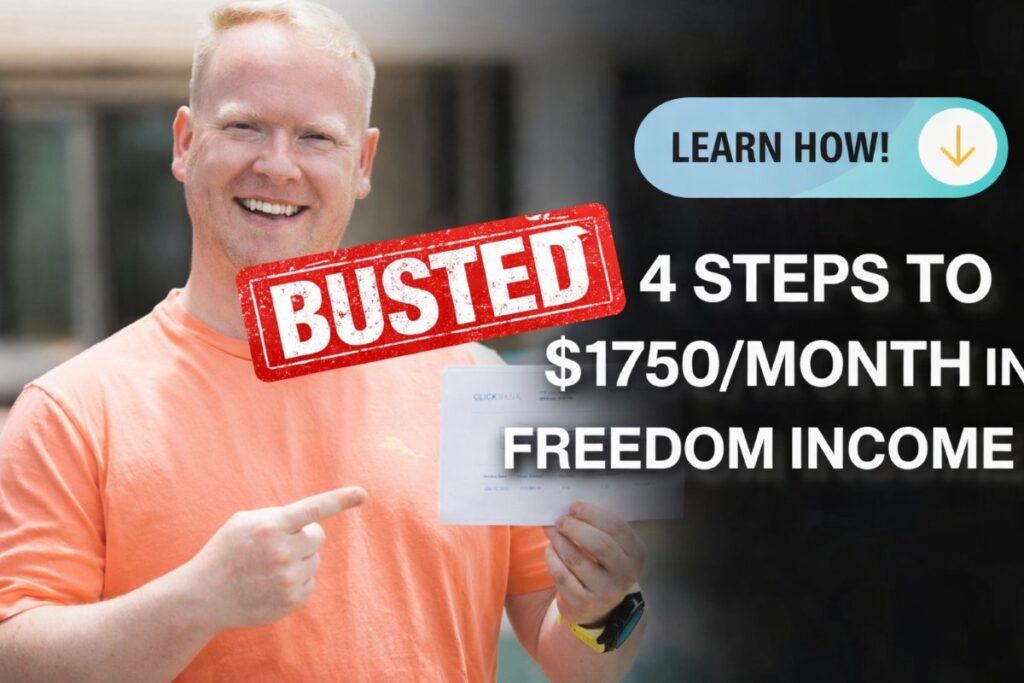
Once someone signs up for Freedom Income, they’re not immediately handed a complete, transparent business blueprint. Instead, they’re introduced to a multi-step marketing funnel designed to guide them through a series of offers over time.
The process usually starts with a free or low-commitment entry point. After opting in with an email address, new users are directed to a video presentation or training that introduces the core concept behind Freedom Income. This presentation focuses heavily on outcomes — financial freedom, lifestyle flexibility, and simplicity — while keeping the technical details intentionally light.
From there, the funnel begins to unfold in stages:
Initial presentation: Explains the opportunity at a high level, often with testimonials or income claims meant to build confidence.
Low-ticket offer: A paid entry product or training designed to move users from “interested” to “invested.”
Upsells and upgrades: Additional products, tools, or training introduced as “necessary” for better results.
High-ticket coaching or mentorship: The final layer, often positioned as the real path to success for those who are serious.
This structure isn’t unique to Freedom Income. It’s a common approach in the online marketing space because it works well for converting paid traffic. Each step is designed to qualify buyers, increase commitment, and maximize the lifetime value of each lead.
The challenge for beginners is that the full scope of the funnel is rarely clear at the beginning. Many people enter expecting a complete system, only to realize later that meaningful progress often depends on continued purchases, ongoing coaching, or paid advertising budgets they weren’t prepared for.
Another issue many beginners run into with funnels like Freedom Income is that they focus heavily on moving people through offers, rather than teaching them how to build something they truly own. The system works best for those who already understand traffic, conversions, and paid advertising — not for someone starting from scratch.
This is why some people eventually start looking for alternatives that prioritize skill-building, transparency, and long-term ownership instead of constant upsells and rebranded launches. Platforms that focus on teaching the fundamentals — websites, content, and organic traffic — tend to offer a much more stable foundation for beginners.
I’ll explain what that looks like later in this review, but first it’s important to understand why Freedom Income feels so familiar once you’ve seen a few of these funnels in action.
Why Freedom Income Feels Familiar

If Freedom Income feels like something you’ve seen before, that’s because it probably is.
One of the biggest red flags for experienced reviewers isn’t a single claim or sales page — it’s repetition. Over time, certain online business models reappear again and again under new names, new branding, and slightly tweaked messaging. Freedom Income fits neatly into that pattern.
I’ve reviewed other programs promoted by Robby Blanchard, and when you compare them side by side, the similarities are hard to ignore. For example, in my review of Laptop Rich Challenge, the structure followed a familiar path: lead capture, motivational training, followed by increasingly expensive upgrades positioned as the “real” path to success. The branding was different, but the mechanics were largely the same.
The same pattern showed up again in Freedom Affiliate Formula. While the sales language emphasized simplicity and automation, the underlying system still relied heavily on funnels, upsells, and paid traffic strategies that most beginners struggle to execute profitably. In both cases, many users reported feeling like they were constantly being moved to the next offer rather than building a stable foundation.
Freedom Income doesn’t appear to be a radical departure from those earlier launches. Instead, it looks more like a repackaged version of a proven funnel, adjusted to match current trends like AI, automation, and lifestyle freedom. This approach makes sense from a marketing perspective — but it also explains why so many beginners end up cycling through multiple programs without seeing consistent results.
When you recognize this pattern, it becomes easier to understand the real risk. It’s not just about whether one program works or not — it’s about getting stuck in a loop of rebranded systems that all require more spending, more tools, and more complexity before any real progress is made.
This is also where comparisons to other well-known funnel marketers start to matter, because the same playbook shows up across multiple brands — not just one name.
This Pattern Isn’t Unique to One Marketer
Freedom Income isn’t the only system using this model. Similar funnel-driven strategies show up in programs promoted by other high-profile marketers, including Adam Cherrington, who has also been running aggressive social media campaigns in recent years.
In reviews I’ve published on Adam Cherrington’s Invisible Affiliate System and Adams Method, the same core structure appears: an initial promise of simplicity, followed by a series of upgrades that are framed as necessary for real results. While the branding and personalities differ, the mechanics remain largely the same — lead capture, emotional positioning, and upsells that aren’t fully disclosed upfront.
This doesn’t mean every program promoted by Adam Cherrington or Robby Blanchard is illegal or fake. It does mean that beginners are often entering these systems without a clear understanding of the total cost, complexity, or skill level required to succeed.
When multiple marketers rely on the same funnel-based approach, it becomes easier to see the real issue isn’t who is promoting the system — it’s how the system is designed.
Is Freedom Income a Scam?
This is usually the point in a review where people expect a simple yes-or-no answer. The reality, however, is more nuanced — and that nuance matters if you’re trying to avoid making the same mistake again with the next program that comes along.
Freedom Income does not appear to be an outright scam in the legal sense. It isn’t a fake website designed to steal credit card numbers, and it doesn’t promise guaranteed income with no effort. The training exists, and the affiliate marketing model itself is real.
That said, legitimacy and suitability are not the same thing.
The biggest issue with Freedom Income is how the opportunity is presented versus how it actually works. Many key elements — such as the true cost of participation, the reliance on paid advertising, and the role of high-ticket upsells — are either downplayed or revealed only after someone has already opted in and committed time or money.
For beginners, this creates a serious problem. People often enter expecting a clear, step-by-step system they can follow at their own pace, only to discover that meaningful progress requires additional purchases, technical skills, or ad budgets they weren’t prepared for. When results don’t come quickly, the natural assumption is that they failed — not that the system was designed for a different type of user.
This is why so many funnel-based programs continue to operate without being scams, yet still leave a trail of frustrated users behind. The system works — just not for the audience it’s most aggressively marketed to.
So is Freedom Income a scam?
No, not in the traditional sense.
Is it a high-risk, funnel-driven program that many beginners misunderstand before joining?
For most people, yes.
And once you understand that distinction, it becomes easier to see why so many newcomers end up searching for alternatives that focus on learning transferable skills, building assets they own, and growing at a pace that doesn’t require constant reinvestment just to stay afloat.
Why Most Beginners Lose Money With Funnels Like This
One of the biggest misconceptions in online marketing is that failure happens because people “didn’t try hard enough.” In reality, many beginners lose money with funnel-based systems like Freedom Income because the structure itself is stacked against them from the start.
First, there’s the issue of paid traffic dependency. Funnels like this are designed to work best when fresh leads are constantly being pushed into the system through ads. Experienced marketers understand testing, budgets, and conversion tracking. Beginners usually don’t — which means they’re often spending money on ads before they fully understand what they’re doing, or worse, before they’ve built any real skills.
Second, these systems rarely focus on ownership. Participants aren’t encouraged to build assets they control, such as their own websites, content libraries, or long-term traffic sources. Instead, the emphasis stays on following someone else’s funnel, someone else’s system, and someone else’s rules. If the program shuts down, rebrands, or changes direction, the user is left with very little to show for their effort.
This is also where the upsell cycle becomes financially draining. Each new upgrade is positioned as the missing piece — the thing that will finally make everything work. Over time, small purchases add up, and many beginners realize they’ve spent far more than they planned without gaining clarity or confidence.
That’s why some people eventually step back and look for platforms that emphasize learning the fundamentals, building skills that transfer across niches, and creating online assets they actually own. Systems that prioritize education, transparency, and long-term growth tend to reduce risk and give beginners room to learn without constant pressure to spend more.
If you’re interested in what that kind of approach looks like in practice, I break it down in detail in my review of My #1 Recommendation, which focuses on skill-building, ownership, and sustainable growth rather than funnels and rebrands.
A Better Long-Term Alternative: Wealthy Affiliate
After reviewing programs like Freedom Income — and seeing the same funnel-based structure repeated across multiple launches — many beginners eventually realize they don’t need another rebranded system. What they actually need is a clear foundation and a place to learn how online business really works.
That’s why my top recommendation is Wealthy Affiliate.
Before finding Wealthy Affiliate, I spent several years — roughly from 2011 to 2014 — jumping from one online business program to the next. Like many people new to affiliate marketing, I was drawn in by big promises, polished sales pages, and systems that claimed to be “plug-and-play.” What I kept running into instead were upsells, pressure tactics, and training that focused more on selling the next product than teaching real skills.
When I first joined Wealthy Affiliate, the difference was immediate. There was no funnel to climb, no hidden coaching pitch, and no urgency-driven sales pressure. In an industry that often felt like constant smog, it was honestly a breath of fresh air. For the first time, the focus was on understanding why affiliate marketing works — not just what buttons to click.
I’ve continued using the training since 2014, not because it promises shortcuts, but because it teaches fundamentals that still work regardless of trends, algorithms, or platform changes. Instead of relying on paid ads or recycled funnels, Wealthy Affiliate emphasizes building websites, creating content, and developing traffic sources you actually own.
This doesn’t mean it’s easy or instant. Real online business takes time and consistency. The difference is that your effort compounds instead of resetting every time a new “system” launches.
If you’re tired of hopping from funnel to funnel and want to build something stable that doesn’t disappear when the hype cycle ends, this is the platform I recommend starting with.
Check Out My #1 Recommendation for Beginners
Final Verdict: Should You Join Freedom Income?
Freedom Income isn’t a mystery once you understand how these systems are built. It follows a familiar, funnel-driven model that relies on strong marketing, emotional positioning, and upsells that appear as you move deeper into the process. For experienced marketers who already understand paid traffic, funnels, and conversions, that structure may feel manageable.
For most beginners, however, Freedom Income creates more confusion than clarity.
The program is marketed as simple and accessible, yet the reality often involves additional costs, ongoing upgrades, and a reliance on skills many newcomers don’t have yet. Instead of building confidence, many users end up questioning themselves — even though the real issue is that the system was never designed with true beginners in mind.
That doesn’t make Freedom Income illegal or fake. It does make it high-risk for people who are just getting started and looking for a stable path into affiliate marketing.
If you’re comfortable with funnels, ad spend, and constant optimization, you may already know what you’re getting into. But if your goal is to learn how affiliate marketing actually works, build assets you own, and grow at a pace that doesn’t require chasing the next launch, there are better options.
That’s why I consistently recommend starting with a platform focused on fundamentals, transparency, and long-term growth — not rebranded funnels and hidden upsells.
👉 My #1 Recommendation for Beginners
Affiliate Disclosure
Some links on this page are affiliate links. This means that if you choose to click through and make a purchase, I may earn a commission at no additional cost to you.
I only recommend platforms and tools I’ve personally used, researched, or believe offer genuine value—especially in an industry filled with hype, rebranded systems, and misleading claims. Any opinions expressed in this review are my own and are based on independent analysis and real experience.
My goal with Scam Busters USA is to help readers make informed decisions, avoid deceptive programs, and understand how online business models actually work—whether or not you choose to use my recommendations.
Frequently Asked Questions (FAQ)
Is Freedom Income legit or a scam?
Freedom Income does not appear to be an outright scam in the legal sense. The training exists, and affiliate marketing itself is a legitimate business model. The issue is how the opportunity is marketed versus how it actually works, especially for beginners who aren’t prepared for funnels, upsells, or paid traffic.
Can beginners make money with Freedom Income?
Some beginners may earn commissions, but most struggle because the system assumes a level of experience with funnels, conversions, and often paid advertising. Without those skills—or a larger budget—results can be difficult to achieve.
Does Freedom Income require paid ads?
While paid ads may not be labeled as “required” upfront, the system heavily favors users who can drive traffic consistently. Many beginners eventually realize that organic traffic and long-term assets aren’t the primary focus.
Why do so many programs like Freedom Income look similar?
Many online business programs reuse the same funnel-based structure because it converts well for the creators. Branding and messaging change, but the underlying mechanics—lead capture, upsells, and coaching tiers—often stay the same.
What’s a safer alternative for beginners?
Beginners tend to do better with platforms that emphasize skill-building, transparency, and asset ownership. Learning how affiliate marketing works from the ground up—without pressure to buy upgrades—reduces risk and builds confidence over time.
About the Author

Hi, I’m Jason.
I’ve been involved in online marketing since the early 2010s, and like many people entering this space, I spent several years getting pulled into hype-driven systems that promised fast results but delivered very little clarity. Between 2011 and 2014, I experienced firsthand how confusing and expensive funnel-based programs can be for beginners.
In 2014, I finally found training that focused on fundamentals instead of pressure and upsells—and I’ve been building and reviewing online business systems ever since.
Today, I run Scam Busters USA, where I publish in-depth reviews and scam alerts to help people avoid misleading programs and make informed decisions. My goal isn’t to sell hype or shortcuts, but to break down how these systems actually work so readers can choose a path that fits their skills, budget, and long-term goals.
Every review on this site is written independently, based on research, pattern recognition, and real experience in the online marketing space.
Your Turn — Join the Conversation
Have you come across Freedom Income or similar programs on Facebook or social media?
Did your experience match what’s described here—or was it different?
I read and respond to comments personally, and your experience may help someone else avoid a costly mistake.
👇 Leave a comment below and share what you’ve seen.
This is my first time on your website, but I am impressed that you are helping your readers understand scams from legit programs. It is so easy for us to be taken advantage of online, so your website is a good resoursce for us all to bookmark.
Thank you for including the section about Robby Blanchard so we can get to know him, I feel it is important to know the person behind programs that we are considering.
Explaining actually how Freedom Income works helps us to understand the program much clearer now. I like how you tell your readers this isn’t actually a scam, but exlain how it actually works instead.
Its very helpful that you recommend Wealthy Affiliate as a legit progam worth considsering, that eases my anxiety about thi program being a real opportunity.
Thank you all the awesome information,
Jeff
Hi Jeff,
Thank you for the warm welcome and the thoughtful comment — I really appreciate it. I’m glad you found the site helpful and that the breakdown made things clearer. You’re absolutely right: it’s way too easy to get taken advantage of online, and that’s exactly why I started this site in the first place.
I’m also happy to hear the background on Robby Blanchard was useful. Knowing who’s behind a program matters just as much as knowing how the program works, and a lot of reviews skip that part entirely.
My goal isn’t to label everything a scam, but to explain things honestly so people can make informed decisions without fear or hype. And yes — recommending a proven, legit platform like Wealthy Affiliate is about giving readers a safer starting point, especially if they’re feeling anxious or unsure.
Thanks again for taking the time to comment, Jeff. If you ever have questions or want a second opinion on something you’re looking at, feel free to jump back in — that’s what the community here is for.
This is a strong example of analytical, reader-first communication. From a communication standpoint, what stands out is how you separate legitimacy from suitability a distinction many reviews miss, but one that adds real credibility here. Your neutral tone, clear signposting, and step-by-step breakdown of the funnel mechanics help readers understand the system without sensationalism or bias. I also appreciate how you manage expectations by explaining why beginners struggle, rather than placing blame on the reader. Overall, this is a well-reasoned, transparent piece that builds trust through clarity and restraint exactly the kind of communication that helps audiences make informed decisions rather than emotional ones.
Kavitha, thank you for such a thoughtful and affirming response. I really appreciate you noticing the legitimacy vs. suitability distinction; that separation is intentional and, as you said, often missing in reviews within this space.
Too many pieces jump straight to labels without helping readers understand who a system is actually designed for and why certain people struggle with it. My goal with this review was to make the mechanics visible, explain the learning curve honestly, and remove the shame factor that often gets placed on beginners when results don’t come easily.
I’m also glad the neutral tone and step-by-step breakdown resonated with you. In a niche that thrives on urgency and hype, clarity and restraint are sometimes the most useful tools we can offer readers. If someone walks away better informed, even if they decide it’s not for them, that’s a win.
Thank you again for engaging so deeply and for articulating the value of reader-first communication so well. Comments like yours reinforce why this approach matters.
Hello Jason!
This was a really clear and honest look at something I’ve seen pop up in a bunch of places online — thank you for breaking it down without all the hype. I’ve definitely felt skeptical about programs that promise big income fast, especially with so many “too good to be true” pitches out there, so it was helpful to read an evaluation that looks at both sides instead of just cheerleading. I loved that you focused on real criteria like transparency, what’s actually taught, and what results people realistically see.
I’m curious — for someone who’s completely new to online income opportunities, what would you say is a good first step to avoid scams while still exploring legitimate training or mentorship? And have you noticed any red flags that are always worth paying attention to no matter how polished a program looks? This definitely gave me a much clearer perspective!
Angela M 🙂
Thank you so much, Angela; I really appreciate you taking the time to share this. I’m glad the breakdown helped cut through some of the noise without leaning into hype. That skepticism you mentioned is actually a healthy starting point in this space.
For someone completely new, the best first step is slowing down and learning how online income actually works before committing money. That means understanding things like how traffic is generated, how offers convert, and where the real value is created, not just being handed a “system” and told to trust it. Legitimate training focuses on skills and transparency, not urgency or secrecy.
As for red flags, a few that almost never fail:
Big income promises tied to short timelines
Pressure to “act now” or risk missing out
Vague explanations about what you’re actually learning
Heavy focus on upsells before results or fundamentals
Success stories without verifiable context or effort explained
Polished branding doesn’t equal legitimacy, clarity does. Programs that are worth your time will clearly explain what’s taught, who it’s for (and who it’s not for), and what kind of work is realistically involved.
Thanks again for such a thoughtful comment, Angela. Conversations like this are exactly why I write these posts, to help people move forward informed instead of burned.
I always love to explore other platforms that offer to teach people the art of making money online, but being a long time member of Wealthy Affiliate, I find that nothing is quite as good as them, or as cost effective. When it comes to training for beginners, I don’t think you will find a system better than Wealthy Affiliate to walk you through everything you need to know about setting up your business and growing it into a sustainable income over time.
Thank you for this review, and it seems many marketers are teaching how to market with funnels now, which is interesting, but I don’t think very beginner friendly.
Hey Michel,
I really appreciate you sharing your perspective—especially coming from someone with long-term experience inside Wealthy Affiliate.
You brought up a really important point about beginner-friendliness. A lot of these newer programs, including Freedom Income, lean heavily into funnels right out of the gate. While funnels absolutely have their place, they can be overwhelming for someone who hasn’t yet built a foundation in things like content, traffic, and understanding how the whole process actually works.
That’s where I think many beginners get tripped up. They’re introduced to advanced strategies before they’ve had a chance to develop the core skills needed to make those strategies effective.
Wealthy Affiliate does a great job of slowing things down and walking people through that foundation step-by-step, which is why so many people stick with it long term and actually build something sustainable.
I’m glad you pointed that out—it adds a lot of value for anyone reading through and trying to figure out where to start.
— Jason
This was a solid read because you focused on the structure behind the offer instead of getting distracted by branding. The part about these programs being repackaged versions of familiar funnels really stood out. Have you found that most people who struggle with programs like this are actually failing because of the model itself, not because they “didn’t work hard enough”?
Great question, and you nailed the core issue.
In most cases, it’s not about people being lazy or “not working hard enough.” That’s the narrative these programs push, but it’s not the reality.
The bigger problem is the model itself.
Most of these funnels are built on:
Buying into a system
Promoting that same system
Competing with thousands of others doing the exact same thing
That creates a situation where beginners are stepping into a saturated, pay-to-play environment without actually learning foundational skills.
So when people struggle, it’s usually because:
They weren’t taught how to build traffic (SEO, content, audience)
They’re pushed into upsells before they understand the basics
They’re told to scale before they’ve proven anything works
At that point, working harder just means losing money faster.
Now effort does matter, but only when it’s applied to something you actually own:
Your website
Your content
Your audience
That’s where effort compounds instead of resetting every time an ad stops.
So yes, what you said is spot on.
A lot of people aren’t failing because they didn’t try.
They’re failing because they were put into a model that makes success far harder than it should be for a beginner.
Hi Jason, Wow, this review really cuts through the hype! I’ve seen ads for Freedom Income all over social media, and I always wondered how much of it was legit. I really appreciate how you explained the difference between a program being “legitimate” and being beginner friendly. I also like that you highlighted Wealthy Affiliate as a safer, skill-building alternative, it’s helps to know there’s a program that focuses on real foundations rather than just upsells. Thanks for keeping it honest and detailed, Jason. This is exactly the kind of insight I wish I’d had before diving into online business programs! because I also had some experiences with other platforms.
Hi Shafna,
I really appreciate you taking the time to share this—especially since you’ve had your own experiences with other platforms. That perspective matters more than most people realize.
You nailed one of the most important points in this space: just because something is legitimate doesn’t mean it’s beginner-friendly… and that’s where a lot of people get tripped up.
A program can technically deliver what it promises, but if it skips the fundamentals or pushes people too quickly into paid traffic, upsells, or advanced strategies, it leaves beginners overwhelmed and often out of pocket before they’ve built any real foundation.
That’s exactly why I tend to emphasize skill-building platforms. Not because they’re perfect, but because they focus on things that actually last—like understanding how traffic works, how to build content, and how to grow something you control long-term.
And like you said, when you’ve already been through a few of these platforms, you start to see the patterns a lot quicker.
If you don’t mind me asking—what was the biggest challenge you ran into with the other programs you tried?