
Google’s AI Overviews can answer a question before you ever click on a traditional search result. Instead of visiting several websites and comparing what they say, you may get an AI-generated summary at the top of Google that appears to have already done much of that work for you.
But how much should you trust it?
I recently decided to put that question to the test using a subject I know extremely well.
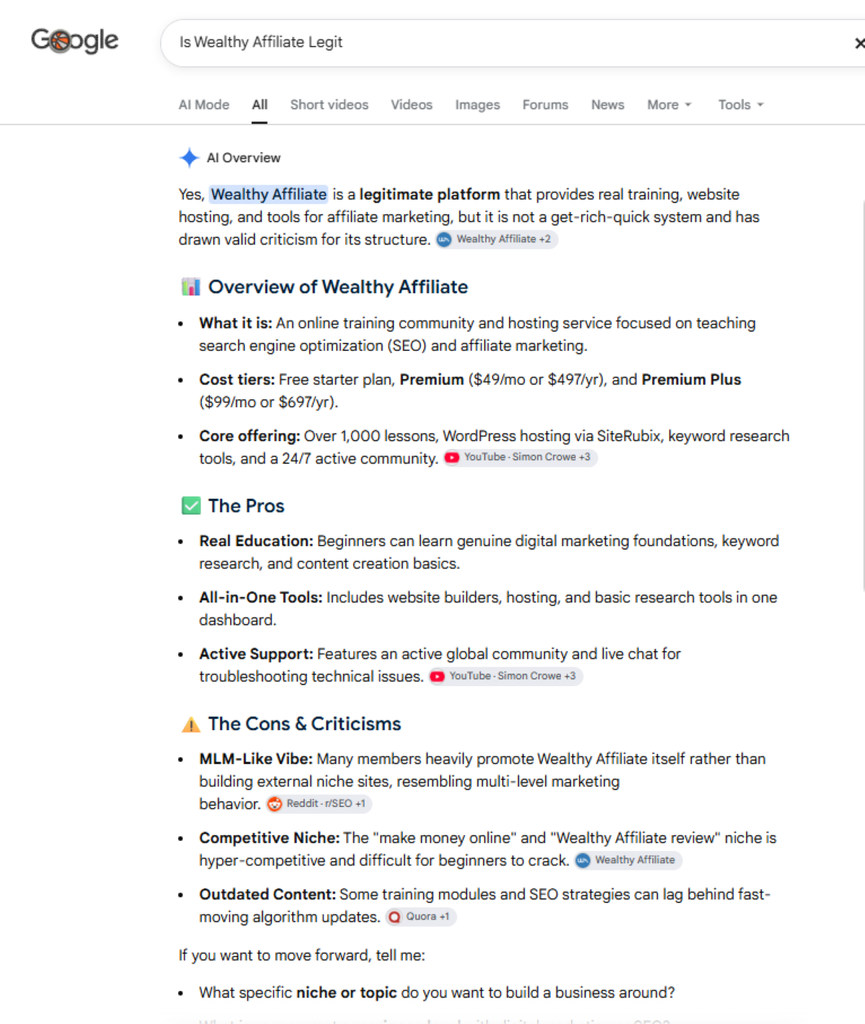
I opened an incognito browser window and searched Google for “Is Wealthy Affiliate Legit.” I’ve been a Wealthy Affiliate member since 2014, so I was curious to see what Google would tell someone who knew nothing about the platform.
At first glance, Google’s AI Overview seemed reasonably balanced. It described Wealthy Affiliate as a legitimate platform offering training, website hosting, and affiliate marketing tools. It also made clear that Wealthy Affiliate isn’t a get-rich-quick system.
Then I reached “The Cons & Criticisms.”
Google described Wealthy Affiliate as having an “MLM-Like Vibe,” saying that many members heavily promote Wealthy Affiliate itself rather than building external niche sites. It also raised concerns about “Outdated Content,” saying that some training modules and SEO strategies can lag behind fast-moving algorithm updates.
Those claims caught my attention.
Not because I immediately assumed Google was wrong, but because they didn’t completely match the Wealthy Affiliate platform I was seeing in 2026.
That presented an interesting opportunity.
Instead of relying on my own experience, defending a platform I’ve used for years, or simply accepting Google’s AI-generated answer as fact, I decided to do what I encourage Scam Busters USA readers to do:
Follow the evidence.
I opened the sources behind Google’s claims, looked at who wrote them and when, and compared what they said with what Wealthy Affiliate actually offers today.
What I found turned this into something much bigger than an investigation of Wealthy Affiliate.
It became a real-world test of a question that increasingly affects all of us:
Can an AI-generated answer accurately summarize information from the internet and still leave you with an outdated or incomplete picture?
That’s what we’re going to find out.
The Google Search That Started This Investigation
On September 29, 2026, I searched Google in an incognito Chrome window for “Is Wealthy Affiliate Legit.”
The AI Overview began with a straightforward answer:
“Yes, Wealthy Affiliate is a legitimate platform”
Google went on to describe Wealthy Affiliate as providing training, website hosting, and tools for affiliate marketing while noting that it isn’t a get-rich-quick system and has received criticism.
The overview listed several positives, including education for beginners, all-in-one tools, and an active community.
But the section that interested me most was “The Cons & Criticisms.”
Google listed three:
MLM-Like Vibe: Google said many members heavily promote Wealthy Affiliate itself instead of building external niche sites.
Competitive Niche: Google said the “make money online” and “Wealthy Affiliate review” niches are highly competitive and difficult for beginners to crack.
Outdated Content: Google said some training modules and SEO strategies can lag behind fast-moving algorithm updates.
Those aren’t insignificant criticisms. Someone researching Wealthy Affiliate before spending money could reasonably factor them into their decision.
And Google wasn’t presenting these statements without sources.
The AI Overview displayed citations beside the claims.
For the MLM-Like Vibe criticism, I could see citations pointing to Reddit and eBiz Facts.
That gave me somewhere to start.
Rather than asking whether I agreed with Google’s AI Overview, I decided to ask a different question:
What happens when we actually open the sources Google used to create it?
Following Google’s Sources
This is where the investigation started getting interesting.
Rather than assuming Google’s AI Overview was right or wrong, I began opening the sources attached to its claims. I wanted to know where the information came from, how old it was, and whether the sources actually supported the way Google summarized them.
The “MLM-Like Vibe” claim was a good place to start.
In my search, Google stated that many Wealthy Affiliate members heavily promote Wealthy Affiliate itself rather than building external niche websites, describing this as resembling multi-level marketing behavior.
The AI Overview showed Reddit as one of the sources supporting that statement. Following that trail led me to a post in the r/SEO community titled “I wasted $19 and 40+ hours on Wealthy Affiliate so you don’t have to…”
There was one immediate problem with using that post to understand Wealthy Affiliate today:
It was approximately seven years old.
That doesn’t make the criticism invalid. If the author accurately described his experience with Wealthy Affiliate at the time, it’s legitimate historical evidence and shouldn’t simply be dismissed because of its age.
But Wealthy Affiliate is an online training and technology platform. Seven years is a long time in SEO, affiliate marketing, artificial intelligence, website technology, and Google Search.
Then I noticed something else.
Google’s AI Overview appeared to have additional sourcing attached to the MLM-like claim, and my investigation eventually led to eBiz Facts, a website containing a detailed critical review of Wealthy Affiliate.
While examining the Reddit discussion, however, I found comments from the original poster directing readers to eBiz Facts and referring to it as “my site.”
In other words, what could initially look like separate criticism coming from Reddit and eBiz Facts had an important connection:
The Reddit post and the eBiz Facts review came from the same person.
Again, that doesn’t mean the criticism is false.
It does mean the sources aren’t completely independent of one another, and that’s important context when an AI-generated answer is synthesizing information from across the web.
This was the point where I realized I needed to look beyond the number of citations appearing beside Google’s answer.
I needed to investigate the age of the information, who was behind it, whether apparently separate sources were actually independent, and—most importantly—whether the claims still described Wealthy Affiliate as it exists today.
And the first claim worth putting under the microscope was Google’s description of an “MLM-Like Vibe.”
Is Wealthy Affiliate Really Like an MLM?
The phrase “MLM-Like Vibe” immediately stood out to me because affiliate marketing and multi-level marketing are not the same business model.
According to the Federal Trade Commission, an MLM typically creates multiple levels of participants through recruiting. Your recruits, the people they recruit, and subsequent levels form what is commonly called your downline. Participants may earn compensation connected to activity within that sales network. Federal Trade Commission
That distinction matters.
I’ve been a Wealthy Affiliate member since 2014 and have participated in its affiliate program. I can refer someone to Wealthy Affiliate and earn a recurring commission while that person remains a paying member.
Let’s clear the elephant from the room. Yes, if you join Wealthy Affiliate using my affiliate link and decide to go Premium, I DO earn a recurring commission as long as you remain a paid member. That’s an affiliate marketing commission, not a multilevel commission.
But if that person becomes an affiliate and refers someone else, I don’t receive a percentage of their commission simply because they’re underneath me. There isn’t a second level of referrals generating commissions for me, followed by a third level and so on.
That’s very different from the traditional upline/downline structure I associate with multi-level marketing.
I have firsthand experience with that model as well. Years ago, during my Plug-In Profit Site days, I joined SFI (Strong Future International). SFI used terminology and structures such as sponsors, uplines, downlines and multiple levels of affiliates—the type of structure people generally associate with network or multi-level marketing.
I’ve previously investigated that program in my SFI Strong Future International review.
What Wealthy Affiliate’s Current Affiliate Program Shows
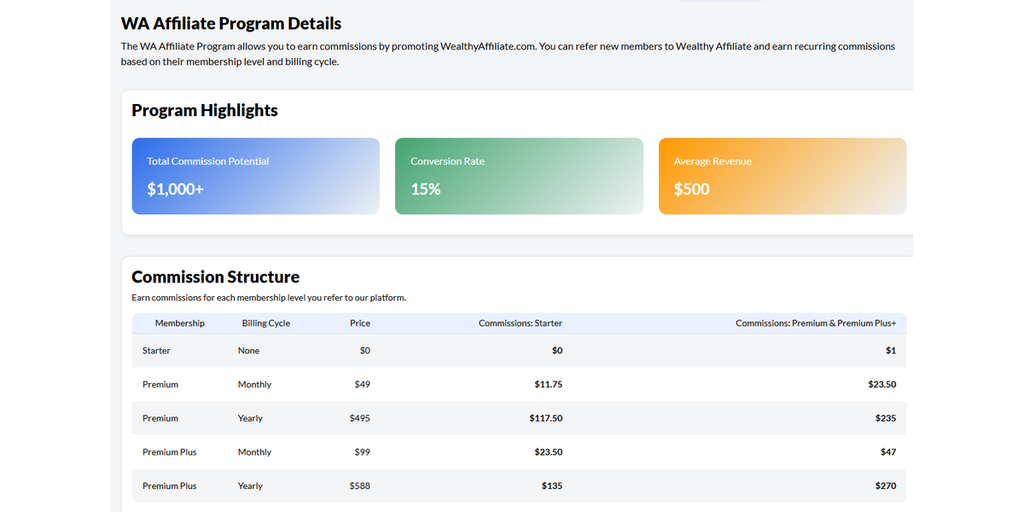
Rather than relying solely on my experience, I logged into my Wealthy Affiliate account and checked the current affiliate program documentation.
The commission table showed payments based on the membership level and billing cycle of your referrals. Premium and Premium Plus memberships have different commission amounts, and commissions can recur while a referred member remains subscribed.
What I did not find in the commission information I reviewed was a compensation structure showing additional levels beneath those direct referrals.
No Level 2.
No Level 3.
No percentage of commissions generated by people recruited by my referrals.
That doesn’t prove every possible claim someone could make about Wealthy Affiliate’s business model. The FTC itself cautions that evaluating an MLM is fact-specific and involves looking at the compensation structure, incentives, marketing representations and how a program actually operates—not simply attaching a label based on one characteristic. Federal Trade Commission
But based on the current affiliate documentation I examined, Google’s phrase “MLM-Like Vibe” needs some context.
Why Someone Might Get an “MLM-Like Vibe”
There is another side to this, and I think it’s important to acknowledge it.
Wealthy Affiliate has its own affiliate program. Members can promote Wealthy Affiliate, refer new members and earn recurring commissions.
Some members choose to build websites or content specifically around making money online, affiliate marketing and Wealthy Affiliate itself. If someone encounters a large amount of that promotional content, I can understand why it might feel recruitment-heavy.
That appears to be closer to the criticism Google was summarizing.
But there’s an important difference between saying:
“Some Wealthy Affiliate members heavily promote Wealthy Affiliate.”
and saying:
“Wealthy Affiliate uses a multi-level compensation structure.”
The first is a claim about how some affiliates choose to promote the platform.
The second is a claim about how the compensation system itself is structured.
Those aren’t the same thing.
For readers who want a neutral explanation of how multi-level marketing structures work, the Federal Trade Commission’s MLM guidance is worth reading directly. FTC guidance on multi-level marketing
So Was Google’s AI Overview Wrong?
I’m not ready to say that.
Remember Google’s actual wording: “MLM-Like Vibe.” It didn’t explicitly state that Wealthy Affiliate is an MLM.
That’s an important distinction, and Google’s underlying criticism—that some members heavily promote Wealthy Affiliate itself—is something we can investigate separately.
But the phrase can also leave a reader with an impression about Wealthy Affiliate’s compensation structure that deserves more explanation than the AI Overview provided.
And that brings us to the next major claim Google surfaced:
Is Wealthy Affiliate’s training actually outdated?
Is Wealthy Affiliate’s Training Actually Outdated?
The next criticism in Google’s AI Overview was “Outdated Content.”
Google stated that some Wealthy Affiliate training modules and SEO strategies can lag behind fast-moving algorithm updates.
Unlike the MLM comparison, this criticism isn’t something I wanted to dismiss quickly. In fact, it’s a reasonable concern for any affiliate marketing training platform.
SEO has changed dramatically. Google Search has changed. Artificial intelligence has changed how people research and create content. Social media, video, email marketing, paid traffic and even the way people discover products continue to evolve.
Training that worked several years ago may not be enough today.
So once again, I followed the criticism back to its sources.
The “Outdated Training” Criticism Has Been Around for Years
One of the sources I examined was eBiz Facts, which publishes a detailed Wealthy Affiliate review.
The review doesn’t mince words.
It says Wealthy Affiliate’s all-in-one approach “seems to have been effective up until about 2016” and argues that its core blogging strategies became outdated.
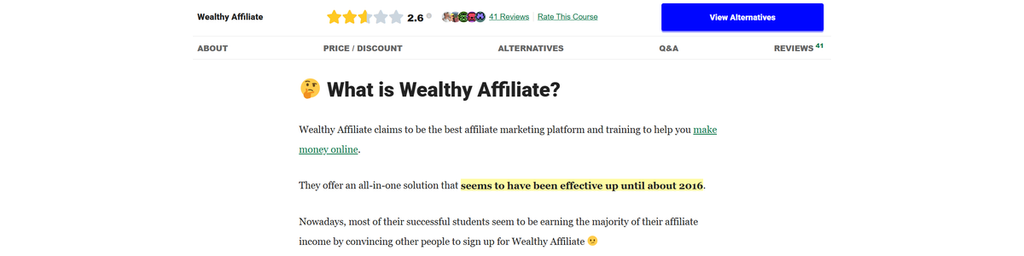
The site’s summary of student feedback also includes “Outdated content” as a recurring criticism, stating that users have complained that some of the training no longer reflects modern affiliate marketing techniques.
Those are legitimate criticisms to investigate.
But when I started looking deeper into the supporting material, I noticed something important:
Some of the member experiences behind these criticisms were several years old.
I found reviews and comments from periods such as 2021, 2022 and 2023 discussing training that members believed needed updating.
Again, their age doesn’t make those experiences false.
If a Wealthy Affiliate member found parts of the training outdated in 2022, that’s useful evidence about what that member encountered in 2022.
But we’re now in 2026.
That changes the question.
Instead of asking:
“Has Wealthy Affiliate ever had outdated training?”
I wanted to know:
“Does Wealthy Affiliate have outdated training today?”
I Went Back Inside Wealthy Affiliate
Because I’m still a member, I didn’t have to rely exclusively on reviews to answer that question.
I logged into the platform and looked at the current Core Training.
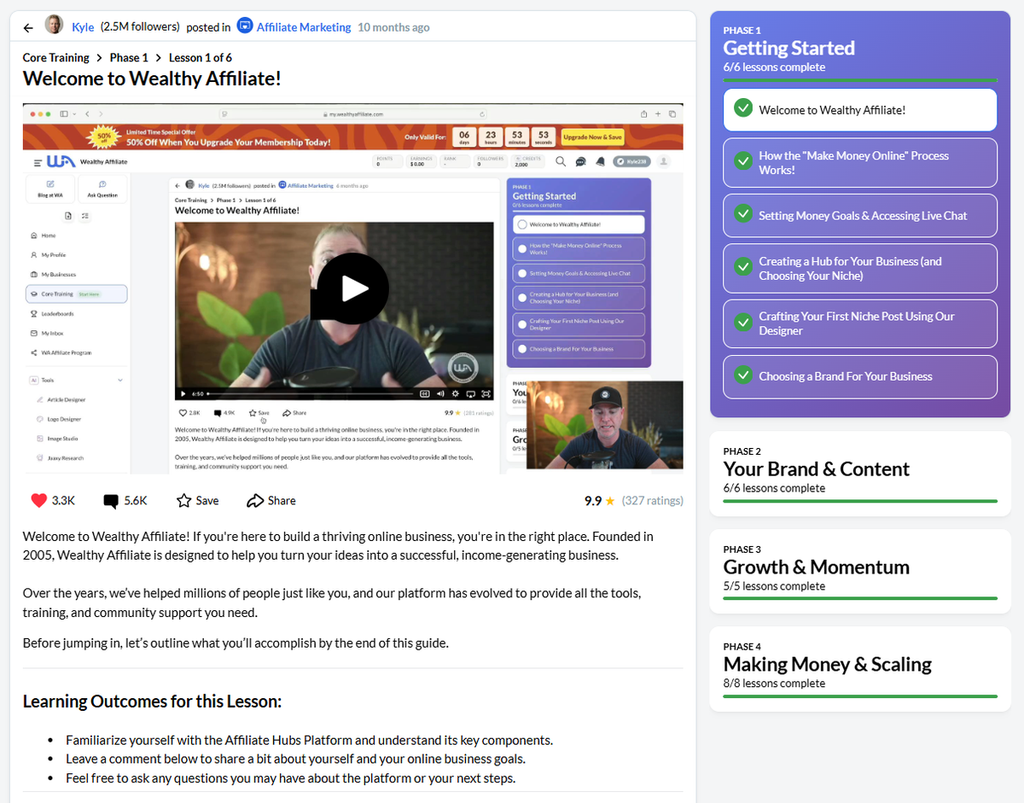
The curriculum I found included recently posted lessons covering the fundamentals of building an online business, creating a niche website and brand, developing content, generating traffic, monetization and scaling.
More importantly, the current training wasn’t limited to the old formula of writing blog posts and waiting for Google rankings.
One of the training graphics lays out the process as Foundation → Traffic → Monetization.
Under traffic, Wealthy Affiliate currently references channels including Google, YouTube, Facebook, TikTok, Pinterest and Instagram alongside SEO and paid advertising.
The platform also now incorporates AI tools for tasks such as content creation, research, planning and image generation.
That doesn’t automatically prove that every Wealthy Affiliate lesson is current.
It certainly doesn’t prove that every strategy taught there will work for every member.
But it does establish something important for this investigation:
The Wealthy Affiliate platform I examined in 2026 isn’t identical to the platform described in reviews written several years earlier.
An Old Criticism Can Be True and Still Become Outdated
This is where our Google AI case study gets particularly interesting.
Suppose someone wrote in 2022 that a particular Wealthy Affiliate training module was outdated.
Suppose that criticism was completely accurate at the time.
Then suppose Wealthy Affiliate replaced or updated that training afterward.
The original review doesn’t suddenly become dishonest. It remains a valid record of what that person experienced.
But using it several years later to describe the current product creates a different problem.
The information itself may not be false.
The context has changed.
That’s an important distinction when evaluating an AI-generated answer. An AI system can accurately summarize something written on the web while still giving a reader an incomplete impression if it doesn’t adequately account for when that information was written and what has changed since then.
And in this case, there was another piece of current evidence I couldn’t ignore.
Wealthy Affiliate’s co-founder recently announced that the company is undertaking an even larger rebuild of the platform specifically because of how dramatically online business and AI are changing.
We’ll come back to that.
First, I want to show you what the current Wealthy Affiliate training actually looks like.
What Wealthy Affiliate Is Teaching Today
If older reviews are going to be used to characterize Wealthy Affiliate’s training in 2026, I think it’s only fair to look at what members actually see when they log into the platform today.
That’s exactly what I did.
The current Core Training begins with the fundamentals, but it quickly moves into building a brand, creating content, generating traffic, monetizing that traffic and eventually scaling the business.
What caught my attention during this investigation wasn’t simply that the training had been updated. It was the range of traffic and business-building methods now being discussed.
One current Wealthy Affiliate training graphic breaks the process into three basic stages:
Foundation → Traffic → Monetization
The foundation begins with building a website and brand.
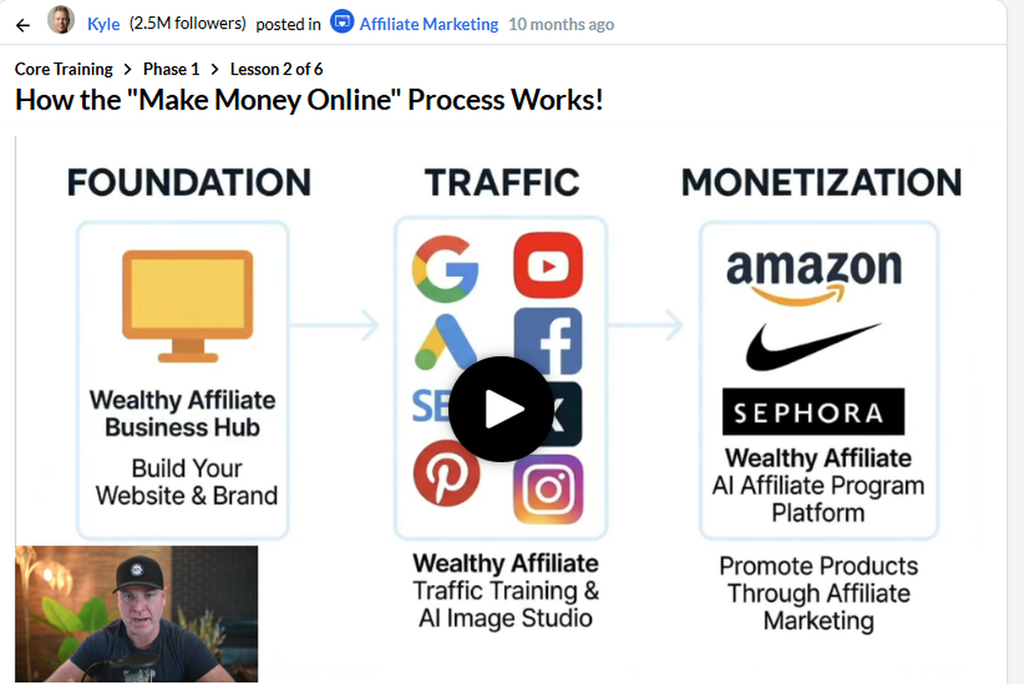
Traffic isn’t presented as coming from Google alone. The training references Google, YouTube, Facebook, TikTok, Pinterest and Instagram, along with SEO, paid advertising and other methods of attracting an audience.
Then comes monetization through affiliate programs.
That matters because one of the criticisms we encountered suggested that Wealthy Affiliate members tend to focus heavily on promoting Wealthy Affiliate itself rather than building independent niche businesses.
Yet the current training material I examined doesn’t present Wealthy Affiliate as the only monetization option. It uses outside companies and affiliate programs as examples of how a niche business can generate revenue.
AI Is Now Part of the Platform
There’s another major difference between the Wealthy Affiliate described in some older reviews and the platform I’m using today:
Artificial intelligence is now built directly into it.
The current training introduces members to AI-assisted tools for researching, planning and creating content. Wealthy Affiliate also provides tools for generating images and assisting with different parts of building an online business.
Does adding AI automatically make a training platform modern?
Of course not.
Slapping an AI button onto an outdated strategy wouldn’t prove much of anything.
What matters is whether the underlying training changes along with the technology and the way people actually find information online.
And interestingly, Wealthy Affiliate’s own founders appear to recognize that challenge.
Wealthy Affiliate Says It’s Rebuilding for What Comes Next
Wealthy Affiliate co-founder Kyle recently published an announcement with a striking title:
“Why We’re Tearing Down 20 Years of Work.” (Affiliate Link)
In the announcement, Kyle says he and co-founder Carson could have taken the easier route of simply adding AI tools to the platform they had already built.
Instead, he says they’re undertaking a much deeper rebuild because a platform designed for the old online-business environment can’t adequately prepare members for the new one.
That’s a significant statement coming from a company that has been operating for more than two decades.
But I also want to be careful about what it proves.
This is Wealthy Affiliate describing its own plans. It isn’t an independent review, and an announcement about what’s coming doesn’t prove that the finished product will deliver on those promises.
What it does establish is that Wealthy Affiliate isn’t claiming the online-business environment has stayed the same.
Quite the opposite.
Its own co-founder is publicly acknowledging that AI and other changes are significant enough that the company believes major parts of a 20-year-old platform need to be rebuilt.
That creates an interesting contrast with the older criticism we found during this investigation.
The question is no longer simply whether someone once encountered outdated training at Wealthy Affiliate.
The more useful question for someone researching the platform today is:
What training exists now, what has already changed, and what is still being rebuilt?
That’s the standard I think we should apply to any constantly changing online product.
And it’s also where Google’s AI Overview runs into one of the biggest challenges we’ve uncovered so far:
The internet remembers old information much longer than the products being described stay the same.
Does the Source Have a Financial Interest?
There was one more thing I wanted to consider before deciding how much weight to give the criticism I found.
Does the person publishing the information have a financial interest in what the reader ultimately chooses?
That’s an important question when researching affiliate marketing because affiliate commissions are everywhere—including on this website.
eBiz Facts openly discloses that its website is reader-supported and that it may earn commissions when readers purchase products through its links.
I actually respect that disclosure.
Affiliate marketing itself isn’t the problem. A website earning a commission doesn’t automatically make its information inaccurate, dishonest or biased.
But the financial relationship is still something readers deserve to know.
eBiz Facts Also Promotes Alternatives
This becomes relevant because eBiz Facts doesn’t simply review Wealthy Affiliate.
The site also reviews and recommends other affiliate marketing training programs. For example, its review of Income School’s Project 24 currently includes a discount code for readers and states that eBiz Facts may earn a commission when purchases are made through its links.
That means there can be a commercial relationship between the reviewer and products that compete for the same type of customer considering Wealthy Affiliate.
Does that prove the Wealthy Affiliate criticism is wrong?
Absolutely not.
And I’d be applying a double standard if I suggested otherwise.
I Have a Financial Interest Too
I’m a Wealthy Affiliate member, but I’m also a Wealthy Affiliate affiliate.
If someone follows one of my affiliate links, joins Wealthy Affiliate and becomes a paying member, I may earn a commission.
You should know that when evaluating what I’m telling you too.
My financial relationship with Wealthy Affiliate doesn’t prove that my information is accurate any more than eBiz Facts earning affiliate commissions proves its information is inaccurate.
That’s why throughout this investigation I’m trying to separate three things:
What Google AI told us.
What Google’s sources claim.
What the evidence actually shows.
When possible, I’m showing you the screenshots, dates and original sources so you don’t have to accept my interpretation—or anyone else’s—without seeing the evidence yourself.
Follow the Evidence, Not the Affiliate Link
This is one of the reasons I’ve become increasingly cautious about online reviews.
A positive Wealthy Affiliate review written by a Wealthy Affiliate affiliate deserves scrutiny.
A negative Wealthy Affiliate review that directs readers toward competing products that can generate affiliate revenue deserves scrutiny too.
Neither relationship automatically tells us whether the review is right or wrong.
The evidence does.
And this raises yet another challenge for AI-generated search results.
An AI can identify webpages that discuss a subject. It can summarize arguments from those pages and display citations beside its answer.
But as readers, we may still need to investigate things the summary doesn’t make obvious:
Who wrote the source?
How old is it?
Are apparently different sources connected?
Does the publisher have a financial relationship with the product being discussed—or with an alternative?
And has the product changed since the criticism was originally published?
Once I started asking those questions, the biggest issue in this case study became much clearer.
AI can bring together information from across the web, but information from different points in time and different commercial contexts isn’t necessarily interchangeable.
The Bigger Problem: AI Can Flatten Time
At this point in the investigation, I started to see a problem that goes far beyond Wealthy Affiliate.
The internet never really forgets.
A review written in 2019 can still rank in Google today. A Reddit discussion from seven years ago can still appear in search results. Complaints about an older version of a product can remain online long after the product itself has changed.
There’s nothing inherently wrong with that. Historical information can be extremely valuable.
The problem comes when information from different periods gets blended together into a single answer without making those differences clear.
That’s something an AI Overview has to deal with every time it tries to summarize the web.
Old Information Isn’t Necessarily Bad Information
This distinction is important.
During this investigation, I found older criticism of Wealthy Affiliate that may have been completely legitimate when it was written.
I’m not going to dismiss someone’s experience simply because it happened several years ago.
If a member thought Wealthy Affiliate’s training was outdated in 2022, that’s their experience. If someone believed too many members were focused on promoting Wealthy Affiliate years ago, that’s worth considering too.
But there’s a difference between saying:
“Members criticized Wealthy Affiliate’s training as outdated in 2022.”
and saying:
“Wealthy Affiliate’s training is outdated.”
The first statement tells you when the criticism applied.
The second can easily sound like a description of the product today.
That’s where context becomes critical.
AI Has to Understand More Than What a Source Says
When we use a traditional Google search, we can see individual results and make some judgments ourselves.
We can look at the publication date. We can recognize Reddit as a discussion forum. We can see that we’re reading a company website, an independent review, a news article or an affiliate website.
An AI Overview does something different.
It takes information from multiple places and attempts to synthesize it into one convenient answer.
Google explains that its AI search features can use a technique it calls “query fan-out,” performing multiple related searches across subtopics and data sources before bringing information together in an AI-generated response.
That can be incredibly useful.
But our case study shows why the age and relationship of those sources matter just as much as the number of sources being cited.
We already encountered one example.
Google’s “MLM-Like Vibe” criticism appeared with multiple sources behind it. But when I followed those sources, I discovered that a Reddit post and the eBiz Facts website weren’t completely independent pieces of evidence—they were connected to the same author.
Now we’re encountering another issue.
Some criticism about outdated Wealthy Affiliate training reflects experiences from earlier versions of the platform, while the current training I documented was posted much more recently and includes AI tools, multiple traffic channels and newer training material.
That doesn’t automatically make the old criticism wrong.
It makes the timeline important.
Accurate Information Can Still Create the Wrong Impression
This may be the most important lesson I’ve taken from this experiment so far.
An AI answer doesn’t necessarily have to invent something out of thin air to mislead you.
Every individual piece of information could potentially come from a real source.
The problem can be missing context.
Who said it?
When did they say it?
Are several sources actually independent?
Has the product changed since the source was published?
Is the AI describing something historically, or presenting it in a way that sounds current?
Those are questions that become easy to overlook when an AI-generated answer appears polished, organized and supported by several citations.
And that’s why I don’t think the lesson from this case study should be:
“Don’t trust Google AI.”
I think it’s something more useful:
Don’t confuse an AI-generated summary with the end of your research.
When the answer could affect what you buy, which company you trust, where you invest your time, or how you judge someone’s reputation, those little source buttons beside the AI Overview may be more important than the summary itself.
Sometimes you need to click them.
That’s exactly what I did here.
Where Google’s AI Overview Got It Right
After spending this much time digging through Google’s sources, I don’t want to leave the impression that the entire AI Overview was wrong.
It wasn’t.
In fact, several important parts of Google’s answer held up quite well.
Google began by describing Wealthy Affiliate as a legitimate platform that provides affiliate marketing training, website hosting and tools. It also warned that Wealthy Affiliate isn’t a get-rich-quick system.
I agree with both of those points.
I’ve been a member since 2014, and nothing I’ve found during this investigation changed that assessment. Wealthy Affiliate provides real training and tools, but joining doesn’t mean you’re suddenly going to start making money online.
Building an affiliate marketing business takes work.
Google was also right to point out that the make-money-online and Wealthy Affiliate review niches are competitive. That’s not something I would dispute. Competition is one of the realities anyone entering affiliate marketing needs to understand.
And even the two criticisms we’ve spent most of this article investigating weren’t simply invented by Google’s AI.
There really are Wealthy Affiliate members who promote Wealthy Affiliate itself. I can understand why someone encountering a large amount of that content might describe the environment as having an “MLM-Like Vibe.”
There have also been real complaints from members who believed parts of Wealthy Affiliate’s training were outdated. We found those complaints during this investigation, and I don’t think they should be erased simply because the platform has changed since some of them were written.
So the problem I found wasn’t that Google fabricated a bunch of criticisms about Wealthy Affiliate.
The problem was context.
A short AI Overview couldn’t show me everything I discovered by opening the citations: how old some of the information was, how two apparently separate sources were connected, how the platform had changed, or the financial relationships that existed on both sides of the argument.
That’s a very different conclusion from saying Google’s AI Overview was simply wrong.
And I think it’s a much more important one.
Because if Google’s AI can give you an answer that is largely based on real information while still leaving out context that could affect how you interpret that information, then knowing how to use these AI-generated answers becomes just as important as knowing whether to trust them.
What Google’s AI Overview Couldn’t Tell Me
Google’s AI Overview gave me an answer in seconds.
Getting the context took considerably longer.
That’s probably the biggest difference between reading an AI-generated summary and actually investigating the sources behind it.
The Overview could tell me that Wealthy Affiliate had received criticism for an “MLM-Like Vibe” and “Outdated Content.” What it couldn’t show me in a few lines was everything I discovered after clicking through those citations.
It didn’t immediately tell me that some of the criticism was several years old.
It didn’t make obvious that the Reddit post and eBiz Facts review were connected to the same person.
It didn’t show me how Wealthy Affiliate’s current training compared with the version being criticized years earlier.
And it didn’t give me the full commercial context surrounding the people discussing the product—including my own financial relationship with Wealthy Affiliate.
None of that necessarily makes Google’s summary false.
But it can change how you interpret it.
The Citation May Be More Important Than the Answer
Before this investigation, I think it would have been easy to look at several citations beside an AI-generated answer and assume Google had already done most of the fact-checking for me.
I don’t think I’ll look at those citations quite the same way again.
A citation tells you where information came from.
It doesn’t automatically tell you whether the source is current, independent, unbiased or describing the same version of a product that exists today.
You may have to determine those things yourself.
That doesn’t mean opening every citation every time you use Google.
If I’m looking up something simple and inconsequential, I’m probably not spending 30 minutes investigating Google’s sources.
But the stakes change when an AI-generated answer could influence whether I spend hundreds of dollars, trust a company, join a business opportunity or make another important decision.
In those situations, I’d rather spend a few extra minutes asking:
Who is behind this information?
When was it published?
What evidence supports it?
Has anything changed since then?
And perhaps most importantly:
What do the original sources actually say?
Google’s AI Overview can be an excellent place to start that research.
After this experiment, I’m much less comfortable treating it as the place where the research should end.
So, Can You Trust Google AI Overviews?
After going through this experiment, my answer isn’t a simple yes or no.
I think Google AI Overviews can be extremely useful.
In this case, Google gave me a quick summary of Wealthy Affiliate, identified several legitimate positives and surfaced criticisms that were based on information that actually existed online.
That’s valuable.
But I also found something I think every Google user should understand:
A sourced answer isn’t necessarily a complete answer.
Google’s AI didn’t need to invent false information to potentially leave me with the wrong impression.
Some of the criticism was old.
Some apparently separate sources were connected.
The product being discussed had changed.
And there were commercial relationships surrounding some of the information that weren’t obvious from the AI-generated summary.
I only discovered those things because I clicked the citations and kept digging.
Trust, But Verify
I’m not going to stop using Google AI Overviews because of what I found.
Actually, I’ll probably continue using them regularly.
They’re fast, convenient and can point me toward information and sources I might otherwise have to find myself.
But I’m going to treat them differently.
For everyday questions where very little is at stake, an AI Overview may be all I need.
For decisions involving money, businesses, products, health, legal matters, someone’s reputation or anything else important, I’m clicking the sources.
I want to know when the information was published.
I want to know who’s behind it.
I want to know whether multiple sources are actually independent.
And when possible, I want to compare criticism with current primary evidence rather than assuming an older description still represents what exists today.
That’s not because Google AI can’t be trusted.
It’s because AI can summarize the research, but it can’t make every judgment for us.
The Most Important Thing I Learned
I started this investigation because Google’s description of a platform I’ve used since 2014 didn’t completely match what I was seeing today.
I expected to find out whether Google’s AI Overview was right or wrong about Wealthy Affiliate.
Instead, I learned something more useful.
The answer can be partly right, properly sourced and still need more context.
That’s why my takeaway from this case study is simple:
Use AI to help you investigate. Don’t let it replace the investigation.
Google gave me the starting point.
The sources gave me the rest of the story.
And sometimes, that difference matters.
Frequently Asked Questions
Are Google AI Overviews always accurate?
No. Google AI Overviews can provide useful summaries based on information found across the web, but that doesn’t guarantee every answer will be complete or current. As this case study demonstrated, even information based on real sources can lose important context when those sources come from different time periods or aren’t completely independent.
Should I trust the sources cited by Google AI?
The citations are a useful starting point, but important decisions may warrant opening them yourself. Check when the information was published, who created it, whether the source has a financial interest, and whether newer information is available.
Is Wealthy Affiliate an MLM?
Google’s AI Overview didn’t actually call Wealthy Affiliate an MLM; it described the platform as having an “MLM-Like Vibe.” In the current affiliate documentation I examined, commissions were shown for referred members, and I did not find additional commission levels for people recruited by those referrals. That’s different from the traditional upline/downline structure I experienced with SFI.
Is Wealthy Affiliate’s training outdated?
Some older reviews and member experiences criticized portions of the training as outdated. However, the current training I examined in 2026 includes newer material covering multiple traffic sources, AI-assisted tools, content creation, monetization and scaling. That doesn’t establish that every lesson is current or effective, but it does show that today’s platform isn’t identical to the version described in some older criticism.
What’s the safest way to use an AI Overview?
Use it as a starting point rather than your only source when the answer matters. Follow the citations, check dates, look for primary evidence, identify possible financial relationships and determine whether apparently separate sources are actually independent.
About the Author

I’m Jason, the founder of Scam Busters USA. I’ve been involved with affiliate marketing for many years and have been a Wealthy Affiliate member since 2014.
I created Scam Busters USA to investigate online business opportunities, marketing programs and questionable money-making claims from the perspective of someone who has actually spent years working in this industry.
I don’t believe every negative review makes something a scam, and I don’t believe an affiliate relationship should prevent someone from asking difficult questions about a product they use or promote.
My goal is simple: follow the evidence, show you what I find, and let you make your own decision.
Affiliate Disclosure
This article contains affiliate links to Wealthy Affiliate. If you click one of those links and later become a paying member, I may earn a commission at no additional cost to you.
I’ve been a Wealthy Affiliate member since 2014, which gives me firsthand experience with the platform, but it also gives me a financial relationship that you deserve to know about.
That relationship doesn’t change the standard I used for this investigation. Where Wealthy Affiliate’s own material was used as evidence, I’ve identified it as such, and where criticism came from outside sources, I’ve tried to represent it fairly.
You should evaluate the evidence for yourself before making a purchase decision.