
Every day, people search for legitimate work from home jobs…
…and most of them end up in the same place.
Confused. Frustrated. Wondering what’s actually real.
Because on the surface, everything looks legitimate.
Job listings.
Professional websites.
Promises of flexible income from home.
But once you start clicking around, a different picture starts to form.
Some want your personal information.
Some try to sell you something before you even understand the job.
And others… don’t really have a job at all.
I know this because I’ve been through it.
I’ve applied to listings that went nowhere.
I’ve clicked into “opportunities” that turned into sales funnels.
And I’ve spent time trying to figure out what actually works—and what doesn’t.
The truth is, legitimate work from home jobs do exist.
But they don’t always look the way they’re advertised.
And if you don’t know what to look for, it’s easy to waste time chasing the wrong things.
That’s exactly why I put this guide together.
Not to hype anything.
Not to sell you a list of “top 10 jobs.”
But to show you what’s real, what’s not, and how to move forward without getting pulled into something misleading.
The Truth About Work From Home Jobs

Here’s something most people don’t realize when they start searching for work from home jobs:
Most of them aren’t really “jobs” in the traditional sense.
They fall into three categories:
Actual remote jobs
Freelance or contract work
Opportunities disguised as jobs
The first two are legitimate.
The third is where most people get into trouble.
A real work from home job looks just like a normal job—just done remotely.
You apply.
You interview.
You get hired.
You’re paid for your time or your output.
No upfront costs.
No confusing sales process.
No pressure to upgrade anything.
But that’s not what most people run into first.
Instead, they find listings that lead to landing pages.
Or “training programs” that require payment before you even understand what you’re signing up for.
Or systems that promise income—but don’t clearly explain how that income is generated.
That’s where the confusion starts.
And if you don’t understand how the online space actually works, it’s easy to go down the wrong path.
I break that down in more detail here:
How To Make Money Online Safely (Without Getting Scammed)
Because now you’re not evaluating a job…
You’re trying to figure out whether you’re being sold something.
And if you don’t know the difference, it’s easy to go down the wrong path.
I’ve been there.
And once you start recognizing the patterns, you realize something important:
The issue isn’t that work from home jobs don’t exist…
It’s that they’re buried under a lot of noise.
The Biggest Problem With Work From Home Opportunities
The biggest problem with work from home opportunities isn’t that they don’t exist.
It’s that most people are introduced to them the wrong way.
Through ads.
Through social media.
Through promises that sound better than reality.
“Make money from home with no experience.”
“Start earning this week.”
“Simple system anyone can follow.”
On the surface, it sounds exactly like what people are looking for.
Flexible income.
No commute.
A way to get started quickly.
But once you click through, things start to shift.
The job becomes an “opportunity.”
The opportunity becomes a “system.”
And the system leads to a sales process.
Before you know it, you’re no longer applying for a job…
You’re being guided through a funnel.
Low-cost entry points.
Upsells.
Vague explanations of how money is actually made.
I’ve gone through this more times than I can count.
And after going through hundreds of these funnels over the past decade, the patterns become hard to ignore.
Different names.
Different branding.
Same structure underneath.
Once you see it, you stop chasing opportunities—and start questioning them.
That’s the shift most people never get to.
And it’s usually because they don’t have a clear way to evaluate what they’re looking at.
If you want to understand how to break these down step-by-step, I walk through that process here:
How To Verify Affiliate Marketing Offers (Before You Promote Them)
Because once you know what to look for, everything starts to make a lot more sense.
Legitimate Work From Home Jobs That Actually Pay
Now that we’ve cleared up what to avoid, let’s talk about what actually works.
Because legitimate work from home jobs do exist…
They’re just not always packaged the way people expect.
Most of them require either:
A company hiring you remotely
A skill you can offer
Or a system you build over time
Here are some of the most realistic paths.
Remote Customer Service Jobs
This is one of the most common entry points into working from home.
Companies are constantly hiring remote representatives for:
Customer support
Technical support
Order processing
These are real jobs with real pay.
You apply through the company.
You go through a hiring process.
You get paid hourly or salary.
The trade-off?
You’re still trading time for money.
It’s stable—but not flexible in the way most people imagine.
Freelance Work (Writing, Design, and More)
Freelancing is one of the most accessible ways to start working from home.
If you have—or are willing to learn—a skill like:
Writing
Graphic design
Video editing
Web development
You can offer those services to clients online.
Platforms like Upwork and Fiverr make it easier to get started, but the real value comes from building your own client base over time.
This path gives you more control…
But it also requires effort upfront.
And without skill development, it’s hard to stand out.
Virtual Assistant Work
Virtual assistants help businesses with day-to-day tasks like:
Email management
Scheduling
Data entry
Customer communication
This is another legitimate path that doesn’t always require advanced skills to get started.
However, like customer service roles, you’re still trading time for money.
The upside is flexibility.
The downside is limited scalability unless you build it into something bigger.
Affiliate Marketing (Done The Right Way)
This is where things start to shift.
Affiliate marketing isn’t a job in the traditional sense.
It’s a business model.
And that’s where most people get misled.
When done the wrong way, it looks like everything we talked about earlier—funnels, upsells, and unrealistic income claims.
But when it’s done the right way, it’s about:
Learning how to create content
Helping people solve real problems
Recommending products or services that actually provide value
That’s it.
No hype.
No pressure.
No shortcuts.
If you’re wondering whether affiliate marketing actually works, I break that down here:
Does Affiliate Marketing Really Work
And if you want to see a real example of how it plays out when things go wrong:
Lessons Learned From A Failed Affiliate Campaign
This isn’t the fastest path…
But it’s one of the most scalable.
Selling Products or E-Commerce (Brief Overview)
Another legitimate option is selling physical or digital products online.
This could include:
E-commerce stores
Print-on-demand products
Digital downloads
This path can work—but it comes with its own challenges:
Inventory (in some cases)
Upfront costs
Marketing and logistics
It’s not as simple as it’s often made out to be.
And like everything else, it requires learning how the business actually works.
The common thread across all of these?
None of them are “instant.”
None of them are “push-button.”
And none of them work without effort.
But they’re real.
And once you understand the difference between a real opportunity and a misleading one…
You stop wasting time on the wrong things—and start focusing on what actually moves you forward.
What Most “Work From Home Jobs” Won’t Tell You
This is the part that most articles skip.
Not because it’s complicated…
But because it doesn’t sell as well.
The truth is, legitimate work from home jobs still require effort.
They require time.
They require consistency.
And in most cases, they require learning something new.
There’s no system where you click a few buttons and money starts showing up.
That idea is what pulls people into the wrong opportunities in the first place.
Real work—whether it’s a job, freelancing, or building something online—takes time to develop.
And that’s where a lot of people get discouraged.
They start something.
They don’t see results right away.
And they assume it doesn’t work.
So they move on to the next thing.
Then the next.
Then the next.
I’ve done that.
And it’s one of the biggest reasons people struggle to gain traction online.
If you want a deeper breakdown of why this happens, I go into that here:
Why Most People Fail At Affiliate Marketing (And What It Really Takes to Succeed)
The short version?
It’s not usually the method that fails.
It’s the expectation going in.
When you understand that from the start, everything changes.
You stop looking for shortcuts.
And start focusing on building something that actually has a chance to work.
How To Tell If A Work From Home Job Is Legitimate
By this point, you’ve probably realized something:
Most misleading opportunities don’t look misleading at first.
They look polished.
They sound convincing.
And they’re designed to feel like a real job.
That’s why having a simple way to evaluate what you’re looking at is so important.
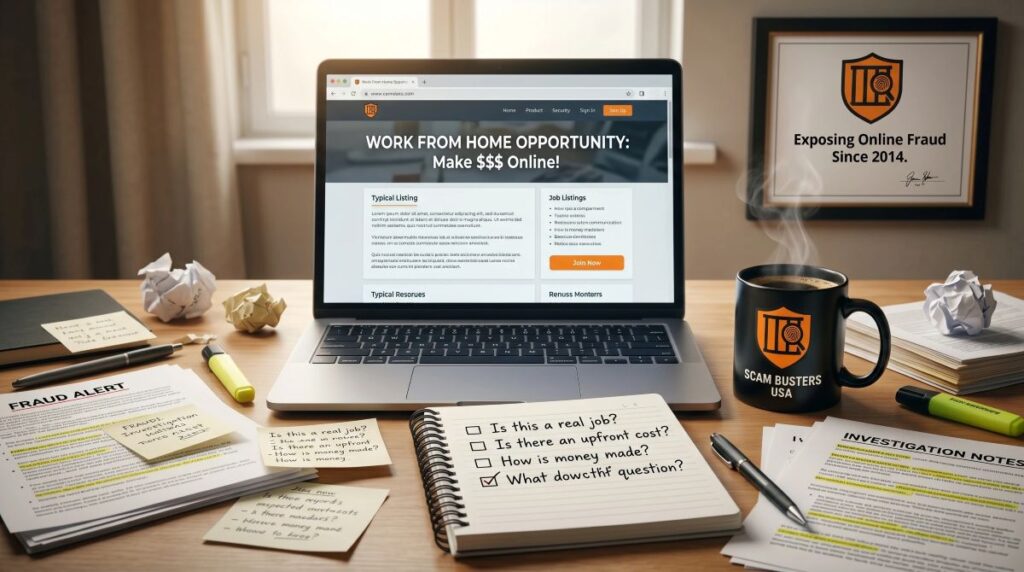
Here are a few questions you should always ask before moving forward with any work from home opportunity:
How Is Money Actually Made?
This is the first question—and the most important.
If you can’t clearly explain how the business generates income, that’s a problem.
Ask yourself:
Who is paying?
What are they paying for?
What value is being provided?
If those answers aren’t clear, it’s not something you want to get involved in.
Is There An Upfront Cost?
Most legitimate jobs do not require you to pay to get started.
If you’re being asked to spend money before you even understand the role, take a step back.
There are exceptions in the business world—but they should come with clear explanations and real value upfront.
What Happens After You Sign Up?
This is where a lot of people get caught off guard.
What looks like a simple opportunity can quickly turn into:
Upsells
Additional “required” purchases
Or a completely different offer than what was advertised
Always take the time to understand the full process—not just the entry point.
Is There Real Training Or Support?
A legitimate opportunity should give you a clear path forward.
Not just vague instructions or motivational content—but actual guidance you can follow.
And if something goes wrong, there should be a way to get help.
Does It Feel Rushed Or Pressured?
Any time you see:
“Limited time offer”
“Only a few spots left”
“Act now before it’s too late”
That’s a signal to slow down—not speed up.
Legitimate opportunities don’t need to pressure you into making a decision.
If you want a deeper, step-by-step breakdown of how to evaluate these types of offers, I walk through that process here:
How To Verify Affiliate Marketing Offers (Before You Promote Them)
Because once you understand how to look at these opportunities objectively…
You stop guessing—and start making informed decisions.
The Shift Most People Need To Make
At some point, most people hit the same realization:
They’re not just looking for a job…
They’re looking for a way out.
More flexibility.
More control over their time.
Something that doesn’t feel like they’re constantly trading hours for income.
And there’s nothing wrong with that.
But here’s where things start to shift.
Because the people who actually succeed working from home usually aren’t chasing jobs forever.
They’re building skills.
That’s the difference.
A job gives you income.
A skill gives you options.
When you develop a skill—whether it’s writing, marketing, design, or something else—you’re no longer limited to a single opportunity.
You can:
Work with different clients
Create your own projects
Adapt as things change
That’s what creates long-term stability.
And it’s also what most “work from home” content never talks about.
Because it takes longer.
It requires effort upfront.
And it’s not as easy to package into a quick promise.
But it’s real.
If you want to explore this direction further, I break it down here:
High-Income Skills You Can Learn Online Without a Degree
You don’t need to have everything figured out today.
But understanding this shift early can save you a lot of time going down the wrong path.
Because once you stop chasing opportunities…
And start focusing on building something…
Everything starts to make a lot more sense.
So What Do I Actually Recommend?
At this point, you’ve probably realized something.
There are legitimate ways to work from home…
But most of them require either time, skill, or both.
And that’s where a lot of people get stuck.
They don’t mind putting in the effort.
They just don’t know where to start—or who to trust.
I’ve been there.
After going through different programs, testing different approaches, and wasting time on things that didn’t work, I eventually realized what I actually needed wasn’t another “opportunity.”
I needed a place to learn how this all works.
Not just surface-level information…
But real training.
Something that showed:
How online income is actually built
How to create something that helps people
And how to do it without relying on hype or pressure
That’s what finally changed things for me.
Not overnight.
Not instantly.
But in a way that actually made sense.
If you want to see the platform I’ve been using since 2014—the one that helped me understand how to build something real—you can check it out below.
This isn’t about jumping into something blindly.
It’s about understanding how to build something that actually works—and having the right environment to do it in.
If you’re not ready for that yet, that’s fine too.
Take your time.
Go back through this guide.
Follow the steps.
And make sure whatever you choose next is something you actually understand.
You can get started for free and go through the first part of the training without paying anything.
If you decide to continue, that’s where the full platform and advanced training come in—the same training I’ve been using since 2014.
There’s no pressure to upgrade, and you can stay a free member as long as you want.
Where To Go From Here
If you’ve made it this far, you already understand something most people miss:
Not everything labeled as a “work from home job” is what it seems.
And more importantly…
You know how to slow down and think through what you’re looking at.
That alone will save you time, money, and a lot of frustration.
From here, the goal isn’t to chase every opportunity you come across.
It’s to choose a direction—and commit to understanding it.
You don’t need to have everything figured out today.
You just need to make better decisions than you did yesterday.
If you want to step back and see how all of this fits together, I recommend starting here:
How To Make Money Online Safely (Without Getting Scammed)
That’s where everything connects.
This guide helps you understand what to look for.
That one shows you how to build the right path.
Take your time.
Go through the process.
And focus on building something that actually makes sense—before jumping into the next opportunity you see.
Frequently Asked Questions
Are work from home jobs actually legitimate?
Yes—but many listings online are misleading. Real work from home jobs exist, but they usually require a hiring process, a skill, or consistent effort over time.
Why do so many work from home jobs feel like scams?
Because many of them aren’t actually jobs. They’re funnels or paid programs disguised as opportunities, often focused more on selling than providing real work.
What is the safest way to start working from home?
Start with something you understand. Focus on real skills or legitimate remote roles, and avoid anything that pressures you to act quickly or pay upfront without clear value.
Can you really make money from home without experience?
Yes—but you’ll still need to learn something along the way. Most legitimate paths require either skill development or on-the-job training.
Is affiliate marketing a real work from home option?
Yes, but it’s not a job—it’s a business model. When done correctly, it’s one of the most scalable ways to earn online, but it requires time, learning, and consistency.
About the Author

Jason Taft, founder of Scam Busters USA
I’m not a guru, and I’m not here to sell hype.
I’m someone who’s clicked the ads, tested the systems, and spent years figuring out what actually works—and what doesn’t—in the make money online space.
Some things worked.
A lot didn’t.
That’s exactly why I created Scam Busters USA.
To break down what’s real, what’s misleading, and help people avoid wasting time on the wrong opportunities.
Everything I share is based on real experience—not theory.
Some links on this page are affiliate links, which means I may earn a commission if you choose to sign up—at no extra cost to you. I only recommend platforms and tools I trust based on my experience, and my goal is to help you make informed decisions—not to push you into anything.
What are “opportunities” that you describe? Are these just the upsell funnels you describe?
Thank you for this website – it is very very very helpful.
Thank you for the kind words—I really appreciate it!
Great question. When I use the term “opportunities,” I’m referring to legitimate ways people can earn income online, including affiliate marketing, blogging, content creation, freelancing, and other online business models.
The funnels I discuss throughout the site are simply marketing systems used to sell various programs. Some are legitimate, some are overhyped, and some I believe should be avoided altogether.
Wealthy Affiliate falls into the category of a platform that teaches people how to build an online business rather than a traditional work-from-home job. That’s why you’ll see me separate jobs from business opportunities throughout the article.
Thanks again for reading and for taking the time to comment!