

If you’ve spent any time on social media lately, you’ve probably seen it.
A short video.
A confident voice.
A promise that you can earn money online using nothing but your phone.
That’s exactly how The Mobile Profit System (mobileprofits.co) is being promoted right now — and it’s why so many beginners are asking the same question:
Is this a legitimate opportunity… or just another recycled affiliate funnel with a new name?
At Scam Busters USA, we don’t rush to label programs as scams — and we don’t promote them blindly either. Our job is to slow things down, strip away the marketing, and explain how these systems actually work so readers can make informed decisions before spending their money.
This review isn’t based on hype, testimonials, or promises of “easy income.”
It’s based on structure, transparency, patterns, and verifiable facts.
If you’re new to affiliate marketing — or if you’ve already been burned by shiny online systems that didn’t live up to their claims — this deep-dive will walk you through:
what The Mobile Profit System claims to offer
what’s clearly disclosed (and what isn’t)
how the funnel really works behind the scenes
who tends to benefit from systems like this — and who doesn’t
By the end, you’ll be able to decide for yourself whether this is something worth your time… or something you’re better off avoiding.
Learn Affiliate Marketing the Right Way (No Funnels)
Transparent, skill-based training — not a system that disappears
Affiliate Disclosure: This article contains affiliate links. If you choose to join through one of them, I may earn a commission at no extra cost to you. I only recommend platforms I believe are more transparent and safer for beginners than the systems reviewed.
What Is The Mobile Profit System?

At first glance, The Mobile Profit System is presented as a beginner-friendly way to earn money online using nothing more than your phone (and sometimes a laptop).
The appeal is obvious: simplicity.
You’re not told you need technical skills.
You’re not told you need to build a website.
You’re not told this will take years to figure out.
Instead, the message focuses on ease, automation, and accessibility — the idea that almost anyone can get started, even with no prior experience.
For people new to online income, that’s an attractive promise.
From what’s shown publicly, The Mobile Profit System is promoted through short videos and simple pages that suggest you’re plugging into a ready-made process, not learning affiliate marketing from the ground up. The impression is that the “system” does most of the work — while you follow along from your phone.
That framing isn’t new.
Affiliate marketing has been repackaged as a “system” for years — sometimes as tools, sometimes as methods, sometimes as blueprints or challenges. The branding changes, but the promise usually doesn’t: simple steps, minimal effort, fast results.
What’s less clear — and where beginners should slow down — is what The Mobile Profit System actually is.
At this stage, it doesn’t clearly define itself as:
a full training platform,
a standalone software product, or
a traditional affiliate education course.
Instead, it’s marketed as a “system” without immediately explaining what skills are taught, what assets you own, or how sustainable the process is over time.
That alone doesn’t mean anything sinister — but it does mean there are important questions that haven’t been answered yet.
And if you’re brand new to affiliate marketing, one thing matters more than any promise made in a video:
Affiliate marketing itself isn’t a shortcut.
It’s a business model that still relies on skills, platforms, and traffic — no matter how “simple” a system claims to be.
I break that down clearly here for beginners:
Does affiliate marketing really work?
In the next sections, we’ll move past surface-level messaging and examine how The Mobile Profit System is actually positioned, what’s explained upfront, and what you’re expected to figure out later.
How The Mobile Profit System Claims to Work

Based on the promotional material and the main walkthrough video, The Mobile Profit System is presented as a step-by-step process designed to guide beginners into earning online without needing to understand the mechanics of affiliate marketing upfront.
The emphasis is not on learning fundamentals first, but on following a sequence.
The general idea is that once you enter the system, you’re shown:
what actions to take,
what links or tools to use,
and how to move traffic through a pre-defined path.
Rather than teaching why certain steps matter, the messaging focuses on what to do next — reinforcing the idea that results come from implementation, not education.
A key theme throughout the presentation is automation.
The system is framed as something already built and optimized, where the user’s role is primarily to:
access the system,
follow instructions,
and use their phone to carry out simple tasks.
This is where the “mobile” angle becomes central. The process is repeatedly described as something you can manage from your phone, without needing to sit at a computer, build assets from scratch, or understand technical details.
What’s noticeably absent at this stage is a clear breakdown of:
how traffic is generated,
what platforms are being relied on,
what skills (if any) are being taught,
or what parts of the process the user actually controls.
Instead, those details are deferred — either implied to be revealed later or treated as unnecessary for getting started.
To a beginner, this can feel reassuring. It removes friction and replaces complexity with momentum. You’re encouraged to move forward without needing to fully understand the business model yet.

But from an evaluation standpoint, this creates an important distinction worth pausing on:
Following steps is not the same as learning a system.
At this point in the presentation, The Mobile Profit System is positioned less like a training program and more like a guided pathway — one where the structure exists first, and understanding is expected to come later, if at all.
That doesn’t automatically make it ineffective. But it does mean readers should be clear-eyed about what’s being offered at this stage: direction, not depth.
For anyone unfamiliar with how affiliate marketing normally works, this difference matters. Long-term results tend to depend on whether you’re building transferable skills and assets — or simply operating inside a framework you don’t control.
If that distinction is new to you, I’ve explained it more fully in this guide on the skills that actually matter in online business.
Essential skills for online entrepreneurs
In the next section, we’ll shift from how it’s presented to something more concrete: who is actually behind the system, how transparent that information is, and why that matters before you commit time or money.
Ownership, Transparency, and Accountability
One of the first things I look for when evaluating any online income system is who is actually behind it.
Not because a program needs a celebrity name attached to it — but because transparency creates accountability.
At the time of writing, The Mobile Profit System does not clearly identify a publicly verifiable individual or company as its creator or operator. Visitors are not immediately shown a named founder, a business entity, or a background explaining who is responsible for developing, maintaining, or supporting the system.
That statement isn’t an accusation. It’s simply an observation based on what is publicly disclosed.
In online business, this kind of opacity isn’t uncommon — especially in systems marketed through funnels rather than established platforms. Still, it raises practical questions that beginners should consider before committing time or money, such as:
Who is responsible if something stops working?
Who controls changes to the system?
Who sets the refund or support policies?
Who has a reputation tied to the long-term success of the program?
Transparency doesn’t guarantee quality, but it does provide a point of accountability. When a platform clearly identifies its creators or operators, users know who they’re trusting — and who stands behind the claims being made.
By contrast, when ownership details are minimal or unclear, users are often asked to place trust in the system itself, rather than in the people or organization responsible for it.
For experienced marketers, this may not feel unusual. But for beginners — especially those new to affiliate marketing — it can make it harder to assess risk. Without knowing who’s behind a program, it’s more difficult to evaluate track record, experience, or long-term reliability.
This doesn’t automatically mean The Mobile Profit System is illegitimate. Many funnel-based systems are built this way. But it does mean that readers should be aware of what information is missing, not just what’s being presented.
Transparency is one of those factors that tends to matter more after the excitement fades — when users need support, clarity, or consistency over time.
In the next section, we’ll move from who’s behind the system to what actually happens after you sign up — including how the process unfolds, what users are likely to encounter next, and where costs or commitments may begin to appear.
The Funnel Anatomy: What Happens After You Join
Once someone decides to move forward with The Mobile Profit System, the experience shifts from broad promises to a more guided, step-by-step path.
This is where systems like this tend to matter most — not in how they’re advertised publicly, but in what users actually encounter after opting in.
Rather than entering an open-ended learning environment, users are generally led into a structured process. The emphasis appears to be on following instructions inside a predefined framework instead of first understanding the fundamentals of affiliate marketing.
The process is typically framed around:
getting started quickly,
completing specific actions in sequence,
and moving through steps as they’re revealed, rather than seeing the full picture upfront.
For beginners, this kind of structure can feel reassuring. There’s less decision-making early on, fewer technical hurdles, and a sense that the path has already been laid out for you.
At the same time, this approach introduces an important dependency.
When progress is tied to a funnel rather than to transferable skills, users are often relying on:
someone else’s pages,
someone else’s systems,
and someone else’s interpretation of what works.
At this stage, key details are often still unclear, including:
where traffic is expected to come from,
which platforms are being leaned on most heavily,
what happens if a particular step stops working,
and how much control the user actually has over the underlying assets.
None of that automatically means the process won’t function as described. But it does mean that users may not fully understand what they’re participating in until they’re already inside it.
This is a pattern that has existed in affiliate marketing for a long time.
Over the years, many funnel-based systems have focused heavily on setup and execution while giving far less attention to traffic fundamentals — leaving users dependent on the system itself rather than equipped to adapt independently.
That’s something I’ve seen firsthand.
One of the earliest examples I personally encountered was Plug In Profit Site, a long-running program that provided pre-built, cookie-cutter websites but offered little practical instruction on how to generate consistent, sustainable traffic. I’ve documented that experience in detail here:
Is Plug In Profit Site a Scam?
The point of that comparison isn’t to say these systems are identical. It’s to highlight a recurring structure beginners should understand:
When a system builds everything for you, but doesn’t clearly teach you how to bring in traffic on your own, progress often depends on factors you don’t control.
This is where the difference between being guided and being educated becomes critical.
Guidance can help you move quickly at the start. Education is what allows you to adapt when platforms change, traffic sources dry up, or a system evolves without you.
Understanding that distinction now makes it easier to evaluate what you’re being offered — not just in The Mobile Profit System, but in any funnel-based opportunity that promises simplicity over skill development.
In the next section, we’ll look at who tends to benefit most from systems like this, and why outcomes can vary so widely depending on experience, expectations, and timing.
Branding Inconsistencies and Reused System Footprints
While reviewing The Mobile Profit System more closely, I noticed something that deserves attention — not because it proves wrongdoing, but because it raises reasonable questions about transparency.
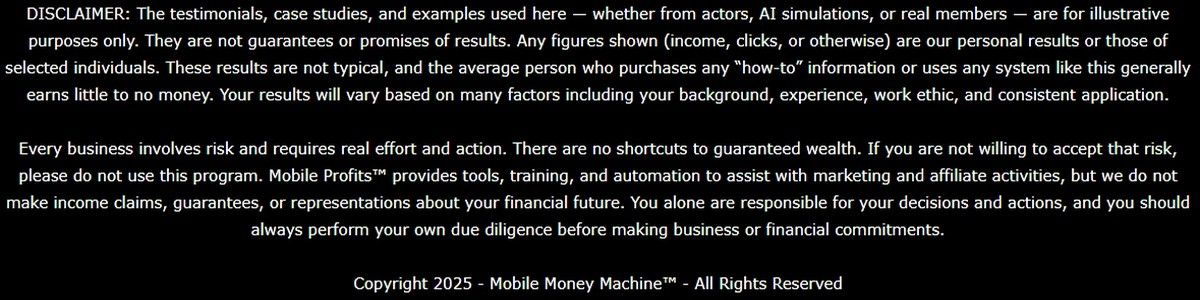
In the promotional materials and walkthroughs, the offer is presented as The Mobile Profit System. However, in the legal disclaimer text and checkout flow, different names appear.
Specifically:
The disclaimer references “Mobile Profits™” and “Mobile Money Machine™”
The checkout branding displays Mobile Money Machine, rather than The Mobile Profit System
These aren’t minor cosmetic elements. Disclaimers and checkout pages are typically where system names, trademarks, and legal identifiers are kept consistent.
When multiple names appear inside the same offer, it often indicates that a system has been rebranded, repackaged, or renamed, rather than built from the ground up as a new platform.
That, by itself, doesn’t make a program illegitimate. Rebranding happens frequently in online marketing — especially in funnel-based systems.
However, it does matter for buyers, because it can:
make independent research more difficult,
obscure the history of a system,
and blur the line between what’s new and what’s simply renamed.
This also helps explain why online searches for The Mobile Profit System can surface complaints, reviews, or AI-generated summaries that appear to reference different program names. When branding changes but the underlying structure remains similar, information gets merged — sometimes incorrectly.
For consumers, this reinforces the importance of focusing less on names and more on structure, transparency, and what skills are actually being taught.
Screenshots documenting these branding inconsistencies are included below for context.

Who Really Benefits From Systems Like This
When evaluating systems like The Mobile Profit System, it helps to step back and ask a simple but often overlooked question:
Who tends to benefit most from this structure — and why?
That answer isn’t always obvious from the marketing, especially when the messaging focuses on accessibility, automation, and ease.
In funnel-based systems, outcomes often depend less on the system itself and more on where someone enters the ecosystem and what they already understand.
Early Promoters and Experienced Marketers
Those who already understand affiliate marketing fundamentals tend to benefit the most from structured systems.
Why?
Because they:
recognize how funnels work,
understand traffic sources,
know how to interpret conversion data,
and can adapt when something underperforms.
For experienced marketers, a system can simply be a vehicle — not a crutch. They’re less dependent on step-by-step instructions because they already understand the mechanics underneath.
In those cases, results come from experience, not from the system itself.
Beginners Following Instructions
For beginners, the experience is usually very different.
Someone new to online income may follow every step exactly as instructed and still struggle — not because they did anything wrong, but because they don’t yet understand:
where traffic is really coming from,
why certain steps matter,
or how to adjust when results stall.
When a system emphasizes execution without education, beginners can end up stuck inside the framework — able to follow directions, but unable to troubleshoot independently.
This is often where frustration sets in.
Not immediately.
But weeks or months later — when progress slows and there’s no clear explanation why.
Timing and Expectations Matter
Another factor that quietly influences outcomes is timing.
Many systems work best for:
early adopters,
those entering during aggressive promotional cycles,
or users who already have an audience or traffic source.
Late entrants may find that:
recommended strategies are saturated,
platforms have changed policies,
or competition has increased significantly.
That doesn’t mean success is impossible — but it does mean expectations need to be realistic.
The Common Thread
Across many systems like this, the same pattern tends to emerge:
Those who benefit most are not relying on the system to teach them how online business works. They’re using it as one tool among many.
Those who struggle are often hoping the system itself will bridge the knowledge gap — and that’s a much heavier burden for any single framework to carry.
Understanding that distinction helps remove emotion from the decision-making process. It shifts the question from:
“Will this system work for me?”
to:
“What am I actually learning — and will that knowledge still help me if this system disappears?”
That question becomes especially important when evaluating any opportunity marketed around simplicity, automation, or mobile-only income.
In the next section, we’ll begin drawing a clearer contrast between system-dependent approaches and skill-based affiliate marketing, which will naturally lead into why I ultimately recommend a different starting point for most beginners.
System-Based Income vs Skill-Based Affiliate Marketing
By this point in the review, a clearer distinction starts to emerge — not just about The Mobile Profit System, but about two very different approaches to making money online.
One approach is system-based.
The other is skill-based.
Understanding the difference between the two often matters more than the name of any individual program.
How System-Based Models Typically Work
System-based income models are built around pre-assembled frameworks.
You’re usually given:
a predefined process,
specific steps to follow,
and tools or pages you didn’t create yourself.
The promise is efficiency. Instead of learning how everything works, you’re told to trust the structure and move forward quickly.
For some people — especially those who already understand affiliate marketing — this can be useful. A system becomes a shortcut because the fundamentals are already understood.
But for beginners, system-based models often come with trade-offs that aren’t obvious at the start:
Limited understanding of why steps work
Little control over underlying assets
Dependence on a process you didn’t design
Difficulty adapting when something changes
When results slow or stop, users may not know how to adjust — because they were never taught how the pieces fit together.
How Skill-Based Affiliate Marketing Is Different
Skill-based affiliate marketing takes a slower path at the beginning, but a more stable one over time.
Instead of plugging into a finished framework, the focus is on learning:
how traffic actually works,
how content attracts the right audience,
how trust and conversions are built,
and how platforms change over time.
Progress may feel slower early on, but the trade-off is ownership.
When you understand the skills behind the business:
you’re not locked into one system,
you’re not dependent on one funnel,
and you’re able to pivot when conditions change.
That adaptability is what separates short-term momentum from long-term sustainability.
I’ve written more about the specific skills that matter most — and why skipping them often leads to frustration later — in this guide:
Essential skills for online entrepreneurs
Why This Distinction Matters Here
The Mobile Profit System is positioned much closer to the system-based side of the spectrum.
The emphasis is on:
following instructions,
leveraging a predefined structure,
and minimizing the need to understand the underlying mechanics.
Again, that doesn’t automatically make it ineffective. But it does mean the outcome depends heavily on how long the system remains intact — and how well it continues to perform under changing conditions.
For beginners deciding where to start, the more important question isn’t whether a system looks easy.
It’s whether the time and effort invested will still pay off after the system is gone.
That’s the lens we’ll use in the next section, where I explain why I personally recommend a different starting point for most beginners — and what makes that alternative safer and more transparent.
Affiliate Disclosure
Some links on this page are affiliate links. This means that if you choose to purchase through them, I may earn a small commission at no additional cost to you. I only recommend programs and training I personally trust and believe will genuinely help beginners and intermediates avoid scams and build legitimate online income.
See a Skill-Based Alternative to Funnel Systems
Learn how affiliate marketing actually works — without recycled systems.
Why I Recommend a Safer Starting Point for Beginners
After reviewing systems like The Mobile Profit System — and having personally gone through similar funnel-based programs over the years — I’ve learned that where you start matters just as much as what you start with.
Most beginners don’t fail because they’re lazy or incapable.
They struggle because they’re dropped into systems that prioritize execution before understanding.
That’s why, for readers who are genuinely interested in affiliate marketing but want to avoid recycled funnels and unclear structures, I usually point them in a different direction.
My #1 Recommendation: Wealthy Affiliate
I recommend Wealthy Affiliate not because it promises fast or effortless income — it doesn’t — but because it does a few important things most systems avoid:
It teaches how affiliate marketing actually works, not just what to click
It focuses on skill development before monetization
It’s transparent about the learning curve
And it doesn’t rely on hidden funnels or surprise upsells
Instead of plugging you into a finished process, Wealthy Affiliate walks you through building something you actually understand and control.
That difference matters.
What Makes This a Safer Starting Point
For beginners, the biggest risk isn’t choosing the “wrong” system — it’s never learning why things work.
Wealthy Affiliate emphasizes:
understanding traffic and content,
building assets you own,
learning how platforms change,
and developing skills that transfer beyond any single method.
That doesn’t mean success is guaranteed. But it does mean your effort compounds instead of resetting every time a system changes names or disappears.
I’ve broken down my full experience — including what I like, what I don’t, and who it’s actually for — in this detailed review:
My Honest Wealthy Affiliate Review – An Up-To-Date Look Inside
If you’re still undecided, it also helps to step back and ask a broader question before committing to any platform:
Does affiliate marketing really work?
That context alone can prevent a lot of frustration later.
A Quick Note for Skimmers (Transparency Matters)
If you’re coming here from social media and just want a clear answer:
Systems like The Mobile Profit System focus on simplicity and speed
Skill-based platforms focus on understanding and sustainability
If your goal is to build something you can adapt and grow over time, the second path is usually the safer one.
That’s why Wealthy Affiliate remains my recommended starting point for most beginners.
Frequently Asked Questions About The Mobile Profit System
Is The Mobile Profit System a scam?
At this stage, it’s more accurate to say that The Mobile Profit System is a funnel-based opportunity with limited transparency, rather than rushing to label it a scam.
It promotes simplicity, automation, and mobile-only income, but does not clearly explain:
what skills are taught,
what assets users own,
or how sustainable the process is long-term.
That lack of clarity is why caution is warranted — especially for beginners.
Can you really make money using only your phone?
A smartphone can be used to manage parts of an online business — checking stats, responding to messages, monitoring campaigns.
But affiliate marketing itself still relies on:
traffic sources,
platforms,
content or ads,
and systems that don’t disappear just because the screen is smaller.
When programs imply that the phone itself is the business, that’s where expectations can drift away from reality.
Is The Mobile Profit System beginner-friendly?
It may feel beginner-friendly at first because it reduces friction and emphasizes following steps.
However, beginners often struggle later if:
traffic isn’t clearly explained,
results slow down,
or they don’t understand how to adapt outside the system.
Beginner-friendly doesn’t just mean easy to start — it means easy to understand and grow with, and that distinction matters.
Why do so many programs look like this?
Because funnels work — especially for marketing.
Over time, many online income programs adopt similar structures:
a simple promise,
a guided process,
limited upfront detail,
and emphasis on action over understanding.
That’s why learning the fundamentals once is often safer than jumping between systems that change names but keep the same structure.
I’ve documented several examples of this pattern over the years on Scam Busters USA, including reviews like The Invisible Affiliate System and Freedom Income-style funnels.
What’s the safest way to start affiliate marketing?
The safest approach usually isn’t the fastest.
It’s starting with a platform that:
explains how the business model actually works,
focuses on skill development,
and lets you build assets you control.
That’s why I generally recommend a skill-based starting point over system-dependent shortcuts.
Final Verdict: Is The Mobile Profit System Worth It?
The Mobile Profit System leans heavily on simplicity, automation, and mobile-first messaging — all of which are appealing, especially to beginners.
But when you look beyond the surface, what’s being offered is guidance inside a framework, not a clear education in affiliate marketing itself.
For experienced marketers, a system like this may simply be another vehicle.
For beginners, it carries a higher risk of confusion, dependency, and unmet expectations.
That doesn’t mean it can’t work for anyone.
It does mean it’s not the safest place to learn the fundamentals.
If your goal is quick momentum inside someone else’s structure, you may find value here.
If your goal is to understand affiliate marketing, build transferable skills, and avoid repeating the same learning curve under different program names, a skill-based platform is usually the better starting point.
That’s why my recommendation remains the same:
If you want to learn affiliate marketing in a transparent, skill-focused way — without recycled funnels or hidden complexity — Wealthy Affiliate is the platform I point beginners to first.
You can read my full, no-hype breakdown here:
My Honest Wealthy Affiliate Review – An Up-To-Date Look Inside
No pressure.
No urgency.
Just the information you need to make the right decision for your goals.
If you’ve had experience with The Mobile Profit System — good or bad — feel free to share it in the comments. Those real-world insights help other readers far more than any sales page ever could.
Start With a Transparent Affiliate Marketing Platform
Build skills you control — not a system you depend on.
About the Author

Hi, I’m Jason Taft.
I didn’t start Scam Busters USA to chase trends or sell shortcuts. I started it because I’ve been on the wrong side of this industry.
Between 2011 and 2014, I was pulled into multiple online income “systems” that promised simplicity, automation, and fast results. Most relied on done-for-you structures, vague explanations, and big promises — and none delivered what was implied. Those years were expensive, frustrating, and ultimately formative.
In 2014, I finally found a legitimate, skill-based path into affiliate marketing — one that focused on understanding how the business model actually works instead of just following steps inside someone else’s system.
That path has continued to evolve with the times. Platforms have changed. Algorithms have changed. Tools have changed. But the core skills I learned back then are still what I use today.
Scam Busters USA exists so beginners don’t have to repeat the same cycle I did — jumping from system to system without ever being taught how online income really works.
My goal isn’t to shame programs or hype alternatives.
It’s to slow things down, explain what’s actually happening behind the scenes, and help readers make informed decisions before they spend their time or money.
If you’d like to learn more about my background, experience, and why I take a cautious, evidence-based approach to online income reviews, you can read more here:
About Me / Why I Started Scam Busters USA
Full Disclosure: Scam Busters USA is reader-supported. Some links in this article are affiliate links, which means I may earn a commission if you choose to make a purchase through them. This does not influence my reviews or conclusions. I aim to evaluate online income systems based on transparency, structure, and risk to beginners.
Your analysis of the Mobile Profit System is super clear! You clearly show that the real difference is not between a “good” or a “bad” system, but between following stupidly and really understanding to build on solid foundations. The promises of simplicity and automation are attractive, but in the long term, they often create dependency and frustration. Conversely, focusing on your skills — capturing traffic, creating your own things, gaining trust — provides stability that lasts. Thank you for this transparency which encourages responsibility and investing in learning rather than shortcuts which quickly fail!
Thank you for this, you really captured the heart of what I was trying to explain.
So many of these systems aren’t “evil” by design… they’re just built in a way that makes people dependent on the funnel instead of helping them understand how online business actually works.
And like you said, that dependency is what turns into frustration later.
When you learn how to get traffic, build trust, and create your own foundation, you’re no longer at the mercy of someone else’s automation or upsells. You actually understand what you’re doing, and that’s where stability comes from.
I truly appreciate you taking the time to share this perspective. Comments like this help other readers slow down and think before jumping into the next shiny promise.