
I’ve been seeing ads for the One Comma Club Challenge everywhere lately.
The pitch is hard to miss.
Build AI-powered funnels.
Earn your first $1,000 online.
No product.
No audience.
No experience required.
At first glance, it honestly looked more polished than a lot of the make money online funnels I investigate here on Scam Busters USA.
After all, this wasn’t some random marketer operating behind a flashy landing page.
This was Russell Brunson and ClickFunnels — one of the biggest names in the funnel-building world.
So I decided to go through the funnel myself and document exactly what happens after you register.
And that’s where things started getting interesting.
What begins as a “free challenge” quickly transitions into countdown timers, VIP upgrades, recurring software trials, emotional sales copy, and multiple upsells tied directly into the ClickFunnels ecosystem.
Now to be clear…
I’m not calling the One Comma Club Challenge a scam.
ClickFunnels is a legitimate company, and some people may genuinely find value in the training.
But I also think beginners deserve to understand exactly how these funnels work before getting emotionally pulled into the excitement of AI marketing and online income promises.
Because once you get past the front-end hype, this challenge is really designed to do one thing:
Move users deeper into the ClickFunnels sales ecosystem.
So in this review, I’m going to walk you through exactly what I found inside the funnel — including the AI claims, pricing structure, upsells, recurring billing setup, and the psychological marketing tactics being used throughout the experience.
TL;DR
One Comma Club Challenge Review TL;DR
- The One Comma Club Challenge is a real training funnel tied directly to ClickFunnels and Russell Brunson.
- The challenge is heavily marketed using AI funnel messaging and beginner-friendly income claims.
- Although advertised as “free,” upsells and recurring software offers appear very quickly after registration.
- The funnel relies heavily on urgency, countdown timers, emotional persuasion, and VIP upgrade pressure.
- This is not necessarily a scam, but beginners should fully understand the backend costs and marketing structure before joining.
- If you’re expecting AI to magically build a profitable online business for you overnight, this probably won’t match reality.
Quick Verdict
The One Comma Club Challenge appears to be a legitimate funnel-building training event connected to the broader ClickFunnels platform.
However, after going through the funnel myself, I believe the marketing can create unrealistic expectations for complete beginners.
The challenge does contain real funnel and online marketing concepts.
But it also uses:
- aggressive urgency
- emotional positioning
- recurring software trials
- and multiple upsells designed to move users deeper into the ClickFunnels ecosystem.
Some people may absolutely enjoy the motivation and training.
But if you’re brand new to online business, it’s important to understand that building profitable funnels usually takes more time, money, testing, and skill development than these sales pages sometimes imply.
Start Here First
If you’re completely new to affiliate marketing and trying to separate legitimate online business training from hype-driven funnel marketing, I strongly recommend reading my Start Here page before buying into expensive systems or software.
What Is The One Comma Club Challenge?
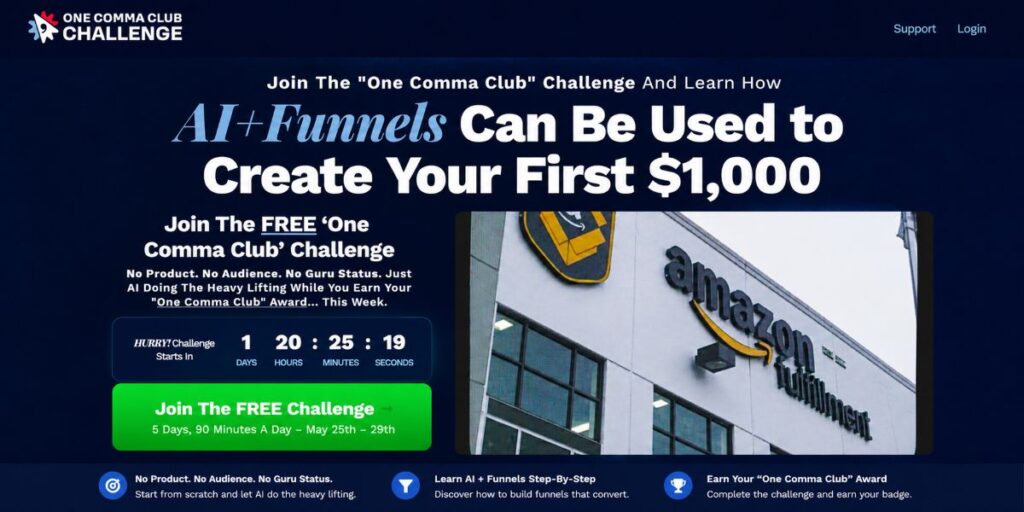
The One Comma Club Challenge is a multi-day online marketing challenge created by Russell Brunson and tied directly to the ClickFunnels platform.
The core pitch is simple:
Use AI and funnels to help beginners make their first money online.
Throughout the funnel, the messaging repeatedly emphasizes that you do NOT need:
- a product
- an audience
- tech skills
- experience
- or even prior business knowledge
Instead, the challenge positions itself as a shortcut into the online business world using AI-powered funnel systems and ClickFunnels templates.
And honestly…
At first glance, the funnel is extremely well done.
Compared to many of the low-quality “make money online” systems I investigate here on Scam Busters USA, this one immediately feels more polished, more professional, and far more emotionally calculated.
The branding is clean.
The messaging is confident.
The videos are professionally produced.
And the sales copy is clearly designed by people who deeply understand online marketing psychology.
One thing I noticed very quickly is how heavily the funnel leans into beginner frustration.
The messaging constantly reinforces ideas like:
- “You’re not too late.”
- “AI is changing everything.”
- “You don’t need experience.”
- “You just need your first win.”
- “This could finally work for you.”
And honestly, I can understand why that type of messaging pulls people in.
A lot of beginners feel overwhelmed trying to figure out affiliate marketing, funnels, AI tools, traffic generation, and online business models all at once.
Funnels like this are designed to simplify that confusion and create emotional momentum very quickly.
But as I moved deeper into the funnel, I started noticing something important:
The challenge itself is only one piece of a much larger sales ecosystem.
Because once you register, the focus quickly shifts toward:
- VIP upgrades
- ClickFunnels free trials
- recurring software offers
- urgency-driven upsells
- and emotional pressure designed to keep users moving deeper into the funnel.
Now to be fair, none of that automatically makes the One Comma Club Challenge a scam.
ClickFunnels is a legitimate company with a massive user base, and Russell Brunson has been one of the biggest names in the funnel-building industry for years.
But I do think beginners should fully understand what type of funnel they’re stepping into before getting emotionally pulled into the AI income promises and “first $1,000 online” messaging.
Because this isn’t just free training.
It’s also a customer acquisition funnel designed to convert challenge participants into long-term ClickFunnels users.
And that becomes much more obvious once you get past the front-end registration page.
If you’re brand new to online business, I’d also recommend reading How To Make Money Online Safely Without Getting Scammed because understanding how these funnels work psychologically can save you a lot of money and frustration later on.
I’d also strongly suggest reading Why Most People Fail At Affiliate Marketing And What It Really Takes To Succeed because one thing these funnels rarely explain clearly is how much consistency, testing, and long-term skill building is actually required to make online business work.
I’ve been through more of these funnels than i’d like to admit, but that’s a good thing for you. Back in 2011 I went through them because I was desperate to make money online. Now I go through them so you don’t have to learn the hard way like I did.
What Happens After You Register?
This is where the funnel really starts to reveal what it’s designed to do.
At first, the registration process feels simple enough.
You enter your email, reserve your spot, and the funnel continues reinforcing the idea that this is your chance to finally break into online business using AI and funnels.
But almost immediately after registration, the tone of the experience changes.
Instead of simply taking users into the training, the funnel quickly transitions into:
- VIP upgrade offers
- countdown timers
- urgency messaging
- “don’t miss this opportunity” copy
- and additional paid offers tied directly into ClickFunnels.
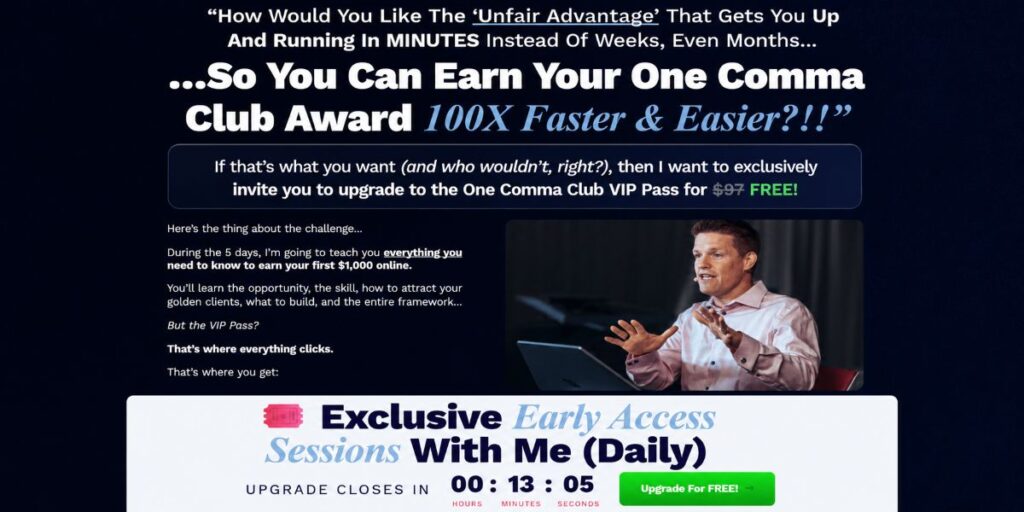
And honestly, this is the point where I think many beginners may start getting emotionally pulled deeper into the funnel without fully realizing what’s happening.
One thing I noticed throughout this process is how carefully the funnel is structured to maintain momentum.
The messaging constantly pushes users toward fast decisions.
You’ll see phrases like:
- “Don’t click away.”
- “This offer is only available right now.”
- “You won’t see this again.”
- “You already made the decision to change your life.”
- “Most people stay stuck because they never take action.”
From a pure marketing perspective, it’s actually very effective copywriting.
The problem is that beginners often mistake emotional momentum for actual business progress.
That’s an important distinction.
Because while the funnel creates a strong feeling of excitement and possibility, building a profitable online business usually requires far more than:
- joining a challenge
- using AI tools
- or following a few funnel templates.
And this is also where the “free challenge” positioning starts becoming more complicated.
Because once you move deeper into the backend, users are introduced to:
- ClickFunnels free trials
- recurring software subscriptions
- VIP passes
- implementation upgrades
- and additional paid tools designed to “accelerate results.”
Again, none of this is hidden exactly.
But I do think the front-end advertising creates a much simpler picture than what users actually encounter once they enter the funnel.
Especially for complete beginners.
If you’ve read some of my other investigations like The Invisible Affiliate System Review or The Shadow Affiliate System Review, you’ll probably notice a similar pattern:
The front-end messaging focuses heavily on simplicity and fast results…
while the backend often becomes significantly more aggressive and sales-driven.
That doesn’t automatically make these systems fake.
But it does mean beginners should slow down and fully understand the long-term costs and expectations before emotionally committing to the funnel.
The Real Cost Of The One Comma Club Challenge
One of the biggest things beginners need to understand about the One Comma Club Challenge is this:
The challenge itself is only the beginning of the financial commitment.
The front-end marketing heavily emphasizes the word “free.”
And technically, yes…
you can register for the challenge without paying upfront.
But once you move deeper into the funnel, additional costs begin appearing very quickly.
During my investigation, I encountered:
- VIP upgrade offers
- implementation add-ons
- ClickFunnels free trial promotions
- recurring software positioning
- and multiple upsells tied directly into the funnel ecosystem.
And this is where I think a lot of beginners can get caught off guard.
Because the marketing often makes online business sound extremely simple.
Just build funnels.
Use AI.
Follow the steps.
Get your first win.
But what often gets minimized is the actual cost of running funnels long term.
For example, once the ClickFunnels trial period ends, users can eventually move into recurring monthly billing for the platform itself.
And that’s before you even factor in:
- paid traffic
- email marketing tools
- domain costs
- funnel testing
- advertising budgets
- or additional coaching and training offers that may appear later.
Now to be fair, software tools are a normal part of online business.
Every legitimate business has expenses.
That’s not the issue.
The issue is whether complete beginners fully understand what they’re signing up for before emotionally committing to the funnel.
Because once urgency, countdown timers, and “don’t miss your breakthrough” messaging get layered into the experience, people can start making emotional decisions instead of financial ones.
And honestly, that’s one reason I always encourage people to slow down before joining systems like this.
Especially if:
- money is already tight
- you’re brand new to online business
- or you’re hoping AI will somehow remove the learning curve entirely.
Because despite what some of these sales pages imply, building a profitable online business still takes:
- time
- testing
- consistency
- patience
- and real skill development.
Funnels and AI tools can absolutely help streamline certain parts of the process.
But they are not magic income generators.
And I think that’s an important reality check many beginners need to hear before entering ecosystems built around recurring software subscriptions and aggressive upsell structures.
If you want a better understanding of what realistic online business building actually looks like, I’d strongly recommend reading What Passive Income Really Means (And What It Doesn’t) because a lot of modern funnels blur the line between long-term business building and emotional income hype.
Who The One Comma Club Challenge Is Probably Best For
After going through the entire funnel myself, I honestly don’t think the One Comma Club Challenge is designed for everybody.
And that’s important to understand before jumping in emotionally because the marketing is extremely good at making people feel like this is their moment to finally break through online.
For some people, the challenge may genuinely be motivating.
Especially if they:
- already understand basic online marketing
- are specifically interested in funnels
- want exposure to the ClickFunnels ecosystem
- or already have a budget set aside for software and business tools.
I could also see experienced marketers enjoying some of the funnel-building concepts and implementation ideas being taught throughout the challenge.
But where I become more cautious is with complete beginners.
Especially people who are:
- financially desperate
- emotionally burned out
- chasing fast online income
- or hoping AI will somehow remove the hard parts of building a business.
Because despite how simple the funnel sometimes makes things sound, there is still a real learning curve involved with:
- funnels
- copywriting
- traffic generation
- conversion optimization
- email marketing
- and online business in general.
And unfortunately, many beginners don’t fully realize that until AFTER they’ve already entered the funnel and started spending money on software, upgrades, or additional training.
That’s why I always encourage readers to slow down anytime a system starts heavily emphasizing:
- “first breakthrough”
- “your moment”
- “you’re not too late”
- or “AI changes everything.”
Because emotional excitement can sometimes override logical decision-making.
And in the make money online space, that can become expensive very quickly.
One thing I will say in fairness to ClickFunnels is this:
The platform itself is real.
People absolutely do build businesses using funnels.
And some marketers genuinely love the ecosystem.
But tools alone do not create successful businesses.
And I think that’s one of the biggest misconceptions beginners walk into with funnels like this.
Because software can help streamline a process…
but it still takes:
- skill
- consistency
- patience
- testing
- and long-term effort to make online business work.
That part rarely fits neatly into a flashy Facebook ad.
If you’re completely new to affiliate marketing, I’d honestly recommend starting with strong foundational education first before jumping into expensive software ecosystems and high-pressure funnels.
That’s one reason I put together my Start Here page — to help beginners understand what realistic online business building actually looks like before getting caught up in hype-driven marketing systems.
Frequently Asked Questions
Is The One Comma Club Challenge Free?
Technically, yes — you can initially register for the challenge without paying upfront.
However, during my investigation, the funnel quickly introduced:
- VIP upgrades
- paid add-ons
- ClickFunnels free trials
- and recurring software offers
So while the front-end registration may be free, many users will eventually encounter additional costs deeper inside the funnel.
Is The One Comma Club Challenge A Scam?
In my opinion, no.
ClickFunnels is a legitimate software company, and Russell Brunson is one of the most recognized names in the funnel-building industry.
That said, I do believe beginners should fully understand the aggressive upsell structure, urgency tactics, and recurring billing setup before joining.
Can Beginners Make Money With The One Comma Club Challenge?
Possibly — but I think many beginners underestimate how much work is actually involved in building a profitable online business.
Funnels and AI tools can help streamline certain tasks, but they do not eliminate the need for:
- skill development
- testing
- consistency
- traffic generation
- and patience
That’s something most sales funnels rarely emphasize strongly enough.
Does The One Comma Club Challenge Require ClickFunnels?
The funnel heavily pushes users toward the ClickFunnels platform during the onboarding process.
Although some concepts may technically apply elsewhere, the challenge itself is clearly designed to move participants into the ClickFunnels ecosystem.
What Happens After The ClickFunnels Free Trial Ends?
If users continue using the platform after the trial period, recurring monthly billing may begin depending on the plan selected during signup.
That’s why I always recommend reading the billing details carefully before entering any software trial tied to an online business funnel.
Is AI Really Building These Funnels Automatically?
Not exactly.
AI tools can absolutely help speed up certain parts of funnel creation like:
- copywriting
- brainstorming
- layouts
- and automation
But beginners should not expect AI to magically create profitable businesses without effort, learning, or ongoing testing.
That’s simply not how online business works in the real world.
Final Thoughts
After spending time inside the One Comma Club Challenge funnel, I can honestly say this is one of the more professionally built systems I’ve investigated lately.
The production quality is strong.
The messaging is polished.
The emotional positioning is carefully engineered.
And the funnel itself clearly understands how to keep users moving forward.
At the same time…
I also think this challenge walks a very fine line between motivation and emotional pressure.
Because once you get deeper into the funnel, the experience becomes much more aggressive than the original “free challenge” ads initially suggest.
That doesn’t automatically make it fake.
But it does mean beginners should approach it carefully and with realistic expectations.
Especially when:
- AI income claims
- countdown timers
- VIP upgrades
- recurring software billing
- and emotional breakthrough messaging
all start getting layered together at the same time.
Personally, I think the biggest risk here is not necessarily the training itself.
It’s the possibility that beginners mistake emotional excitement for actual business progress.
Because building a profitable online business still takes:
- time
- consistency
- skill development
- testing
- and patience
no matter how polished the funnel looks.
And despite what some of the marketing may imply, AI is not going to magically eliminate that process overnight.
So is the One Comma Club Challenge a scam?
In my opinion, no.
But I do believe it’s a highly optimized sales funnel designed to convert users into the larger ClickFunnels ecosystem through emotional marketing, urgency, and recurring software positioning.
Some people may absolutely find value in it.
Others may walk away feeling overwhelmed once the real costs and expectations become clear.
That’s why I always encourage readers to slow down, research carefully, and avoid making emotional financial decisions inside high-pressure funnels.
If you’re looking for a slower, more beginner-friendly path into affiliate marketing without constant countdown timers and aggressive upsells, you can also check out my recommended training below.
And as always, I’d love to hear your thoughts and experiences in the comments below.
Have you gone through the One Comma Club Challenge yourself?
Did you find value in it…
or did the funnel feel more aggressive than you expected?
Affiliate Disclosure: This article may contain affiliate links. If you purchase through my links, I may earn a commission at no extra cost to you. I only recommend products, services, or training programs I believe may provide value. Always do your own research before investing in any online business opportunity.
About The Author

I’m Jason Taft, founder of Scam Busters USA. I personally investigate online business opportunities, affiliate marketing systems, AI funnels, and high-pressure sales funnels to help everyday people avoid hype-driven traps and unrealistic income promises. Rather than blindly promoting every program I come across, I go through these funnels myself, document the upsells, capture screenshots, and break down what’s really happening behind the marketing. My goal is simple: help beginners make smarter decisions before spending money on expensive courses, software, or online business systems.
Good point about the earnings disclaimer and the reality that most people won’t see overnight results. Your breakdown of the upsells and recurring costs was especially useful because that’s the part many reviews tend to gloss over.
I can relate to this topic. Years ago, when I was first trying to make money online, I got pulled into a Ponzi scheme because I was chasing the promise of easy income. Back then the scams were simpler. Today, with social media influencers, AI-generated content, and polished sales funnels, it feels even harder for beginners to spot red flags.
In your experience, what’s the single biggest warning sign that tells you a program is more hype than genuine opportunity? Thanks for the balanced review, Jason.
Hi Hari,
Thank you for sharing your experience. Unfortunately, you’re not alone. Many people get pulled into questionable programs because the promise of fast and easy money can be very convincing, especially when it’s wrapped in professional marketing and success stories.
If I had to pick the single biggest warning sign, it would be when the marketing focuses more on the income than the actual business model or skills required to succeed.
Whenever I see a sales page filled with lifestyle claims, income screenshots, luxury cars, or promises of quick results—but very little information about the work involved, the training provided, or how customers are actually acquired—I immediately become cautious.
Legitimate online businesses usually require learning real skills, creating value, building trust, and putting in consistent effort over time. Programs that make those realities seem optional are often relying on hype rather than substance.
You’re also right that today’s environment is more challenging. AI-generated content, polished funnels, and influencer marketing can make almost any opportunity look credible on the surface. That’s one of the reasons I started Scam Busters USA—to help people slow down, ask the right questions, and look beyond the marketing.
I appreciate you taking the time to read the review and share your story. Comments like yours help other readers realize they’re not the only ones who have been caught up in the pursuit of “easy money” online.
Thanks again, Hari, and I wish you continued success on your online journey.
— Jason